

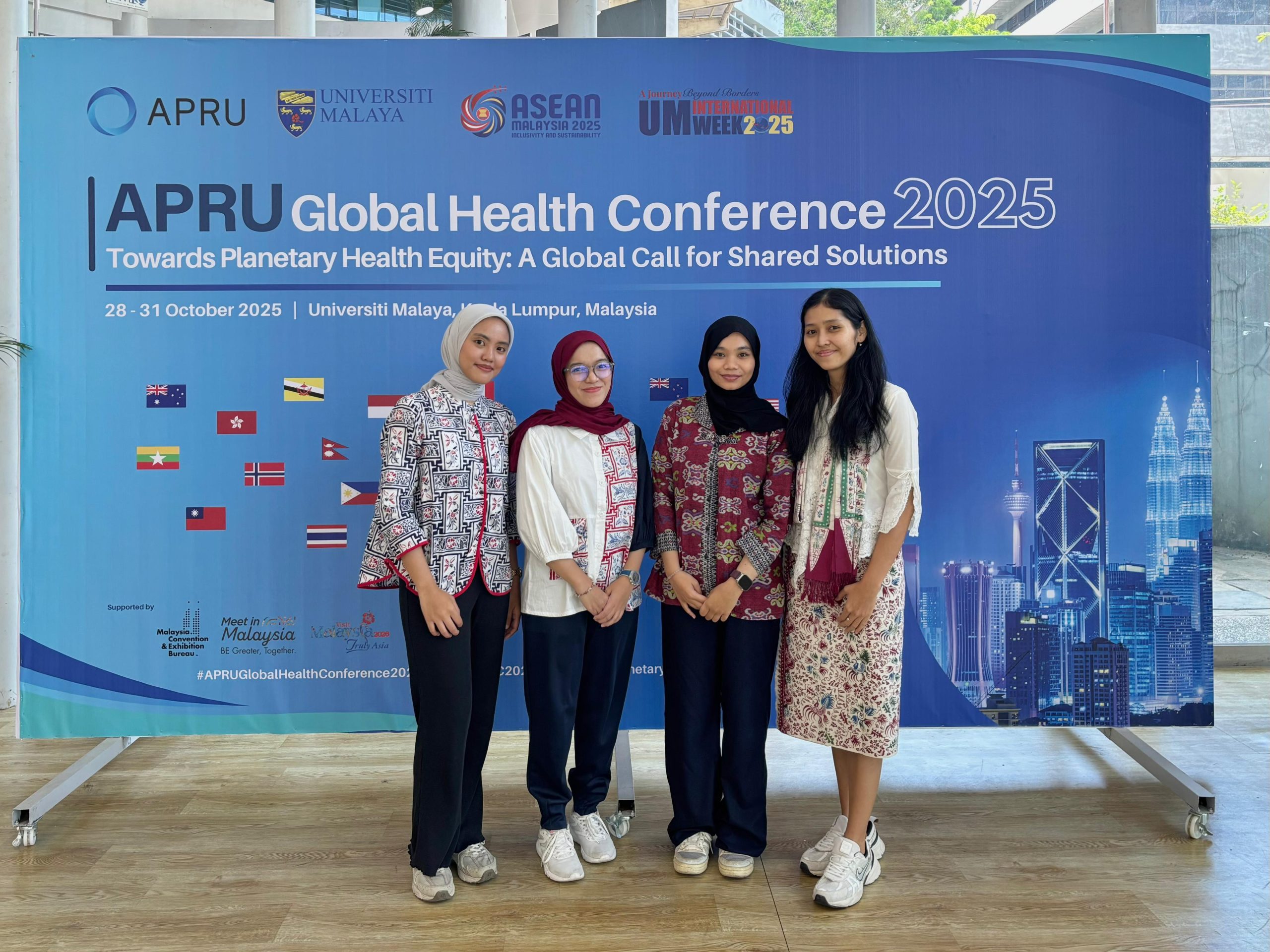
Depok, 3 November 2025 – Students of the Faculty of Public Health (FPH) Universitas Indonesia (UI) have once again achieved international recognition. This time, the HeaLink Team—comprising undergraduate extension students of Public Health, namely Catur Rizki Pindi (Epidemiology concentration, 2024), Istiqomah Hanifah Rachman (Health Policy Administration concentration, 2023), Aliya Nurul Fauziah (Health Policy Administration concentration, 2024), and Anisa Djohan (Health Policy Administration concentration, 2024)—won 2nd Place at the APRU Global Health Conference 2025 Virtual Global Health Case Competition, held on 28–31 October 2025 at Universiti Malaya, Kuala Lumpur, Malaysia. The competition featured 110 teams from 13 countries across the Asia-Pacific region, bringing together students from various nations to share ideas on global health issues under the theme “Advancing Inclusive Growth in Southeast Asia by Leveraging Data and AI for Food Security.”
In this competition, the HeaLink Team presented a video titled “Strengthening Food Availability in Indonesia Through the Integration of Field Data and AI.” The project originated from their final assignment for the Global Health course taught by Dr. Helda, M.Kes. The three-minute video highlights Indonesia’s food security issues by introducing an AI-based WhatsApp bot designed as a tool for community-level food supply reporting and prediction. The technology is intended to help farmers report weather data, harvest outputs, and food needs in their areas. The AI system then processes this information to predict food availability and support more efficient interregional distribution. “We wanted to create something simple yet impactful—something that communities can immediately adopt. Almost everyone uses WhatsApp, even in remote areas, so we saw this platform as a bridge to strengthen food reporting and distribution,” said Pindi, representing the FPH UI team.
The primary inspiration behind the video’s concept came from Indonesia’s historical success in achieving national rice self-sufficiency during President Soeharto’s era, a symbol of the nation’s ability to meet its own food needs. The idea also drew from Indonesia’s strong culture of gotong royong (mutual cooperation), translated into a community-hub model. This community-based approach is highly relevant to Indonesia’s archipelagic context and showcases collaborative values applicable to other countries. According to Pindi, Indonesian students have wide opportunities to demonstrate their potential on global stages like APRU. “Our team was the only one from Indonesia addressing food security. Even though our approach was simple, it was considered relevant and applicable to various international settings,” he added.
Throughout the development process, the team faced challenges such as differing ideas, prototype design issues, and limitations in time and technical capacity. Initially, they planned to develop a new application but later chose to use a familiar platform to ensure effectiveness without adding technological burdens. They also needed to adapt to an international forum format requiring strong English proficiency and cross-cultural communication. Pindi noted that all team members were working while competing, making time management a major challenge. Yet the pressure also fueled their determination. “People need to understand that pressure itself is a challenge. Don’t crumble under pressure—rise and fight. When we are pushed, we must leap higher. Pressure can be the energy that drives us to grow,” he said.
In this competition, evaluation was conducted through voting by APRU members combined with assessments by judges representing APRU member universities. Each team submitted a video for evaluation, and winners were determined based on the combined score. The HeaLink Team from FPH UI received 33 out of 108 total votes.
Although the video’s visuals and cinematography were not as polished as those of some competitors, the judges emphasized that the strength of the idea and its relevance outweighed these aspects. The concept stood out for linking a local Indonesian issue with a global, practical, and low-cost solution. The WhatsApp bot concept was considered innovative, simple, and socially impactful—earning the team second place among more than a hundred international participants.
Pindi stressed that food security involves more than food availability—it is also closely related to accessibility, environment, and social equity. “As public health students, we must always think promotively and preventively. Food security is one of the most crucial issues because it directly affects nutritional status and community well-being,” he said.
The HeaLink Team hopes their innovation will inspire other students to be more active in international forums and confidently present innovative ideas. They also plan to further develop this concept under the guidance of Dr. Helda, M.Kes., and explore opportunities for implementation in academic and community activities.
Dean of FPH UI, Prof. Mondastri Korib Sudaryo, M.S., D.Sc., expressed her appreciation for the team’s remarkable achievement at the APRU Global Health Conference 2025. “This accomplishment reflects the spirit of FPH UI with Noble Character and Excellent Performance. Our students have not only demonstrated academic excellence but also social sensitivity and collaborative spirit in creating real solutions for global health challenges. Simple yet impactful innovation like this proves that noble values, empathy, and hard work can produce internationally recognized contributions. I hope this achievement inspires the FPH UI academic community to continue creating and contributing to society, the nation, and the world,” said Prof. Mondastri.
The APRU Global Health Conference is an annual scientific conference organized by the Association of Pacific Rim Universities (APRU) that discusses global health issues. Universiti Malaya, Kuala Lumpur, Malaysia served as the host institution for this year’s conference. (EAR)