

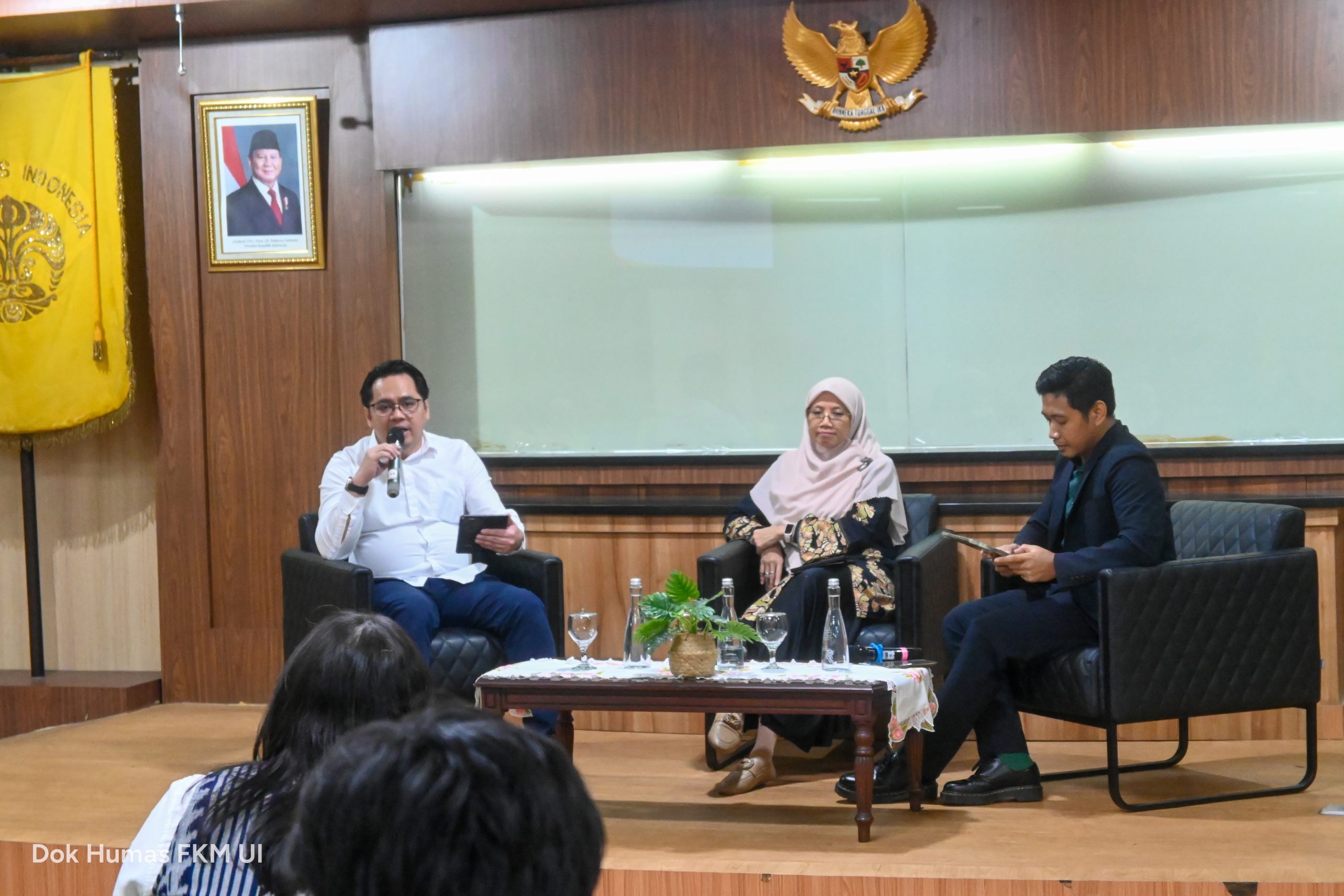
Depok, 9 October 2025 – The Faculty of Public Health (FPH) Universitas Indonesia (UI) held the 9th Online Seminar Series with the theme “Preventive Policies, E-Health Innovations, and Mental Health Investment: Pillars of Sustainable Occupational Health Development Toward Golden Indonesia 2045.” The hybrid event, conducted on Saturday, 8 November 2025 at the Doctoral Promotion Room of FPH UI and via Zoom Meeting, brought together experts from various institutions and disciplines and was attended by more than 1,000 participants from across the country.
The seminar was officially opened by Prof. Dr. Robiana Modjo, S.K.M., M.Kes., Professor of the Occupational Health and Safety (OHS) Department of FPH UI, and Dr. Laila Fitria, S.K.M., M.K.M., Education Manager of FPH UI. In her remarks, Prof. Robiana emphasized the importance of the seminar’s theme, noting that mental health issues have become a major challenge in the world of work. “Data from the Ministry of Health and the Ministry of Manpower show that around 20 percent of Indonesia’s population—about 54 million people—experience emotional mental disorders, including insomnia and fatigue, which affect work performance,” said Prof. Robiana. She further highlighted the importance of digital technology and cross-ministerial collaboration. “Health problems cannot be solved by the Faculty of Public Health alone; they must involve the Ministry of Health, the Ministry of Manpower, as well as the Ministry of Communication and Digital Affairs,” she added.
Dr. Laila Fitria, S.K.M., M.K.M., also emphasized the relevance of the seminar to national health development. “Occupational health and mental health have become increasingly complex challenges. Through the integration of preventive policies, e-health innovations, and investment in mental health, we are preparing the foundation for sustainable occupational health development toward the vision of Golden Indonesia 2045—an era of superior, healthy, productive, and globally competitive human resources,” she stated.
The seminar, divided into two sessions, was moderated by Beny Herman Sulistyo, S.T., a Master’s student in Occupational Health and Safety at FPH UI. The event featured interactive discussions exploring strategies to synergize policies, technological innovations, and mental health in the workplace.
The first session presented materials on Preventive Policies and Digitalization for Occupational Health. Oki Suryowahono, S.T., M.T., Head of the Strategic Policy Center – Public Policy and Communication Agency of the Ministry of Health, discussed the direction of occupational health digitalization. He emphasized that e-Health is one of the key innovations supporting Golden Indonesia 2045, with strengthened data governance that is secure, transparent, and integrated. Oki explained that the implementation of the Personal Data Protection Law (Law No. 27 of 2022) and the Government Regulation on Electronic Systems and Transactions (PP No. 71 of 2019) provides a strong foundation for digital transformation in the health sector. Through programs such as the National Digital Public Service Mall (MPPDN) 2.0 and the Free Health Check Program (CKG), the Ministry is expanding access to digital health services, including licensing for health workers and telemedicine services that are efficient and free of charge. Infrastructure development has also become a priority, with more than 1,300 health facilities in frontier, outermost, and underdeveloped (3T) regions now connected to the BAKTI Komdigi internet network. “Digitalization in health is not just about technology; it is about ensuring that every worker and citizen has equal access to preventive services,” Oki stated.
Meanwhile, Ratu Martiningsih, S.K.G., M.Kes., AAAK., CHIA., Head of the JKN Financing Team – Center for Financing and Health Insurance, Ministry of Health, highlighted the importance of sustainable financing in supporting occupational health. Through the Universal Health Coverage (UHC) approach and primary care transformation, the government aims to strengthen early detection of chronic diseases in primary healthcare facilities (FKTP), which could save up to IDR 210 trillion over the next 30 years. “Promotive and preventive approaches are no longer optional but essential for the sustainability of the national health system,” Ratu explained. She emphasized the need to enhance collaboration between JKN and the employment injury compensation program (BPJS Ketenagakerjaan) to avoid budget overlap and ensure participants receive appropriate benefits.
The second session, delivered in an interactive talk show format, explored real-world experiences regarding mental health, fatigue, and worker productivity. Insights were shared by Dr. Royanul Arief, a Senior Environmental Specialist Physician at SKK Migas, and Ika Malika, M.Psi., Coordinator of Counseling Services at Makara Clinic UI. Dr. Royanul highlighted the importance of implementing Fatigue Risk Management Systems (FRMS) and Employee Assistance Programs (EAP) in high-risk industries such as oil and gas. These preventive approaches not only support workplace safety but also strengthen operational sustainability and corporate reputation. “Workers’ mental and physical health is a strategic asset, not a financial burden,” he stressed. Complementing this, Ika Malika discussed workplace mental health as a key determinant of performance, creativity, and team collaboration. She emphasized promotive and preventive strategies such as mental health literacy, flexible working hours, employee wellness programs, and psychological first-aid training. She closed with a call for organizations to build a “no stigma” culture around mental health and to provide safe spaces for employees. “A supportive workplace that prioritizes psychological well-being will foster productive, creative, and resilient workers,” she concluded.
Through this seminar, FPH UI aims to serve as a strategic platform for collaboration among government bodies, academia, and industry to strengthen a preventive, inclusive, and sustainable occupational health ecosystem. Additionally, FPH UI hopes to build collective awareness that investment in promotive efforts and mental health is not merely an individual responsibility but an integral part of the national strategy to enhance productivity and the well-being of Indonesia’s workforce. (EAR)