


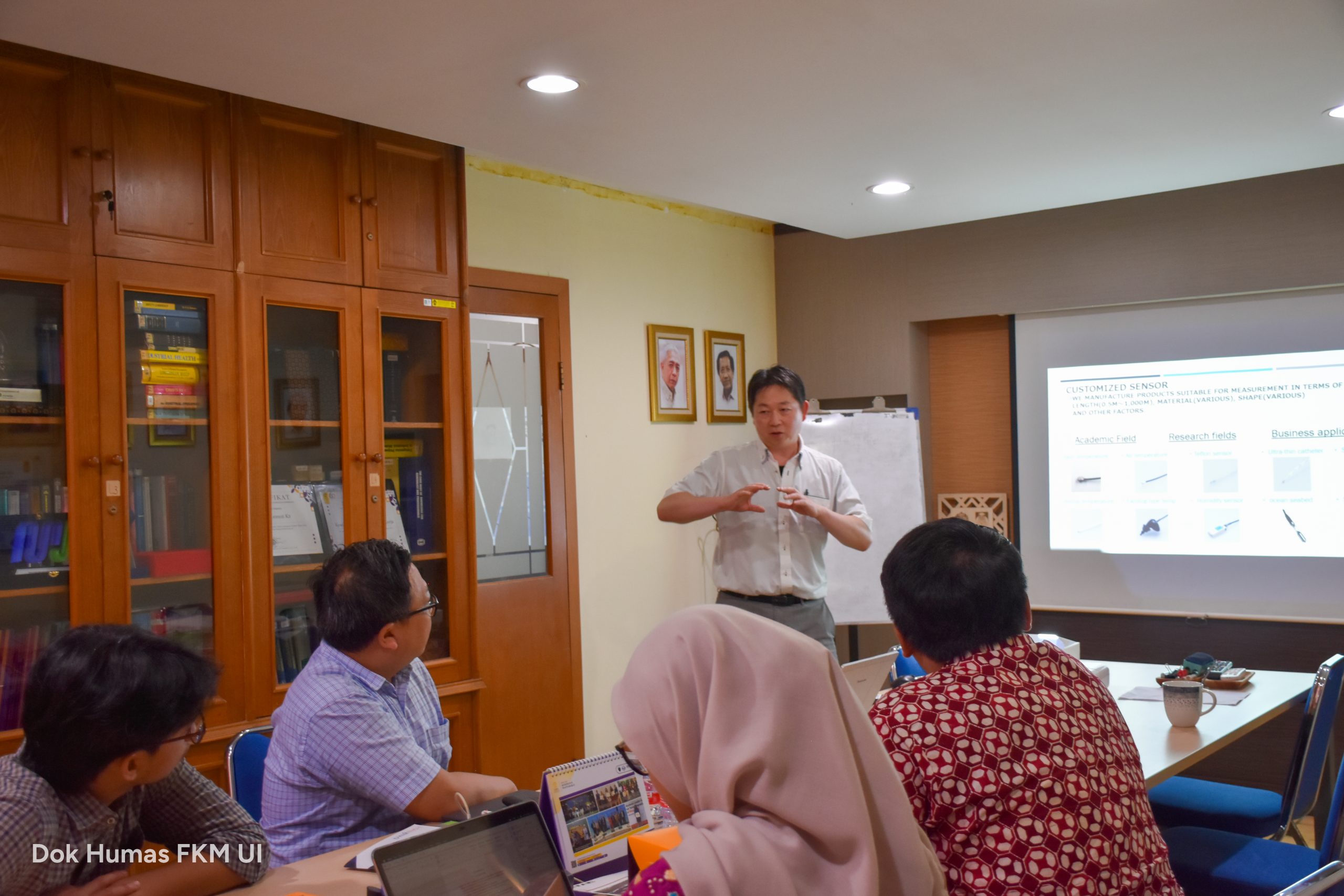
Depok, 23 November 2025 — The Faculty of Public Health (FPH) Universitas Indonesia (UI) received a visit from JP Thermetrics, a company from Japan, to explore potential collaboration in the development of thermal sensors for monitoring human physiological conditions, particularly related to the risks of extreme temperature exposure in the workplace. The meeting, held offline in the Department of Occupational Health and Safety (OHS) meeting room at FPH UI, marked an important step in exploring opportunities for joint research and the advancement of innovative risk-monitoring technologies grounded in scientific evidence.
The discussion included exploration of potential pilot projects in both laboratory and industrial settings. Representing Japan were Mitsuhiro Oketani, Representative Director and President of JP Thermetrics; Donny Ham, Industrial Testing Manager at PT Dynatech International; and Pandega, Sales Representative at PT Galleon. From FPH UI, attendees included Prof. Dr. Indri Hapsari Susilowati, S.K.M., M.K.K.K., Manager of Partnerships, Alumni Relations, and Ventures; Dr. Eng. Stevan Deby Anbiya Muhamad Sunarno, S.K.M., M.K.K.K., Secretary of the Public Health Study Program; as well as Farah from the FPH UI OHS Laboratory.
The meeting opened with a presentation from the Japanese delegation outlining the development of technologies resulting from earlier collaborations with Gram Cooperation, which has now integrated into JPK Maastricht. “In 2023, Gram Cooperation became a fully independent company. Our team later joined and became part of the company, which is now integrated within Gram Cooperation,” explained Mitsuhiro Oketani.
The delegation then introduced a range of physiological sensor devices designed to analyze workers’ bodily responses to extreme temperatures (heat and cold) as well as physical workload demands. These technologies can record multiple parameters through an eight-channel system suitable for various laboratory experiments and real-world work environments. Devices presented included Low Temperature & High Temperature Sensors, Humidity Sensors, Environmental Thermal Sensors, Water Thermal Sensors, Skin Temperature Sensors, Rectal Temperature Sensors, and Tympanic Temperature Sensors. “These sensors are engineered with high accuracy, customizable features, and can record data at millisecond intervals,” added Oketani.
From FPH UI, the OHS Department team emphasized that research on extreme temperature exposure has so far focused primarily on environmental measurements, while workers’ physiological data have received less attention. “Exposure to extreme temperatures, especially heat, has mostly been assessed from environmental conditions alone. Physiological indicators such as increases in core body temperature or skin temperature have not been widely examined, even though they are crucial,” stated Dr. Stevan. The discussion also highlighted the need for wireless devices to support field application. “Field implementation may face challenges if cables are still required. A wireless system would be much more practical,” added Farah.
Responding to this input, the Japanese delegation expressed their readiness to customize sensors based on research needs and field conditions. “These devices can be used for various types of experiments, and the sensors can be customized upon request,” stated a member of the JP Thermetrics team.
Through this visit and technological dialogue, FPH UI and JP Thermetrics are expected to move toward concrete steps for international collaboration to strengthen academic capacity, research innovation, and the development of OHS laboratory facilities. (EAR)