

Depok, 1 December 2025 – Today, we live in an era where human health, environmental health, and planetary health no longer have clear boundaries. The three are so deeply interconnected that even small changes in one aspect can trigger broad and far-reaching impacts. Climate change is no longer a distant threat confined to scientific reports—it has become part of our everyday reality. Floods, droughts, declining air quality, and shifts in rainfall patterns are occurring more frequently, reshaping the ecology of numerous diseases. These conditions have contributed to the rising dynamics of emerging and re-emerging diseases such as leptospirosis, chikungunya, malaria, and other zoonoses that now exhibit new and increasingly unpredictable transmission patterns.
In this context, the Faculty of Public Health, Universitas Indonesia (FPH UI) once again held the 17th Series of its Online Seminar, raising the theme “Dynamics of Emerging & Re-Emerging Diseases Driven by Climate and Environmental Change: Challenges from Local to Global Scale.” The event took place on Saturday, 29 November 2025 in a hybrid format at the Ojo Radiat Auditorium, Education and Laboratory Building, FIK UI (8th floor) and online via Zoom Workplace. It featured speakers from the Ministry of Health of the Republic of Indonesia, the Ministry of Environment and Forestry, the Geospatial Information Agency, Greenpeace Indonesia, FPH UI academics, students, and public participants.
In her opening remarks, Dr. Laila Fitria, S.K.M., M.K.M., Academic Manager of FPH UI, emphasized that behind the major challenges posed by various global issues, there lies enormous potential for the next generation—an opportunity to strengthen the health system, build cross-sectoral networks, and position Indonesia as an active contributor in global climate crisis response. She described the younger generation as those who will lead future health responses to climate-driven threats.
The first session was moderated by Dr. Budi Hartono, S.Si., M.K.M. The first speaker, Dr. dr. Then Suyanti, M.M., highlighted health risks sensitive to climate, ranging from respiratory diseases, heat-related illnesses, vector-borne and waterborne diseases, zoonoses, and non-communicable diseases, to their impact on mental health. She elaborated on the government’s efforts to build a climate-resilient health system. “The government has developed various components of a climate-resilient health system, including strengthened early warning systems (EWARS), climate-health research, sustainable health facility technologies, the Climate-Resilient Village Program (DEKSI), and health disaster contingency plans,” said Dr. Then.
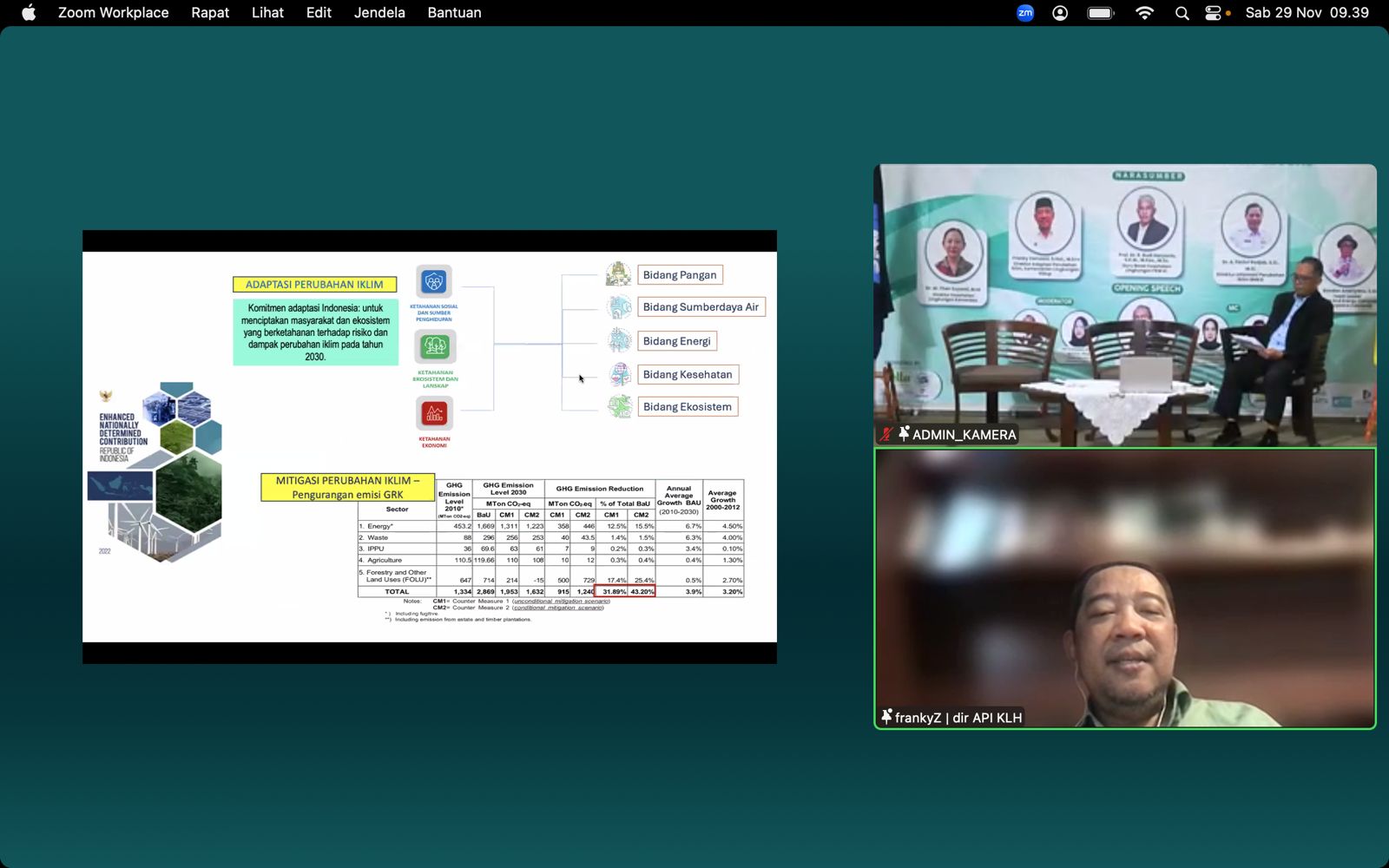
Furthermore, Franky Zamzani, S.Hut., M.Env., explained that health adaptation is now part of the Nationally Determined Contributions (NDC), with strategies including strengthening climate-resilient health service facilities, climate-health early warning systems, enhanced surveillance for climate-sensitive diseases, and improved regional capacity for adaptation planning. “Climate change is projected to increase extreme events that will affect disease incidence, clean water availability, and food security. Therefore, cross-sectoral synergy becomes fundamental, including collaboration across clean energy, ecosystems, food security, and health services,” Franky noted.
Meanwhile, Prof. Dr. R. Budi Haryanto, S.K.M., M.Kes., M.Sc., presented an academic perspective through data showing how climate variability influences patterns of communicable and non-communicable diseases in Indonesia. “For malaria, the data show an increase in Annual Parasite Incidence from 0.8 in 2019 to 1.6 in 2022, demonstrating the sensitivity of transmission to climate change. Air pollution also poses a serious threat, with rising PM2.5 levels strongly associated with increased cases of pneumonia, COPD, and ischemic heart disease,” Prof. Budi explained.
The second session was moderated by Fitri Kurniasari, S.K.M., M.K.K.K., Ph.D. Dr. A. Fachri Radjab, S.Si., M.Si., CPM, opened the session with an overview of global climate conditions in 2024–2025, which marked the hottest period in recorded history. He explained how BMKG provides climate services for the health sector. “BMKG provides climate services for the health sector, including the DBDklim Jakarta system, which offers predictions of air humidity for the next five months and estimates of dengue incidence for the next three months,” Dr. Fachri said. This system is now used by the Health Office for recommendations, public education, and early warnings to health facilities.
On the other hand, Bondan Andriyanu, S.Si., from Greenpeace Indonesia, urged participants to rethink the direction of national development. According to him, any development model that treats health as a secondary effect is fundamentally flawed. “The climate crisis proves that an extraction-based economic model not only destroys the planet but also harms the human body and future generations,” Bondan stated.
Through SEMOL Series 17, FPH UI reaffirms that climate change has become a major determinant of health, influencing the transmission, distribution, and intensity of numerous diseases in Indonesia. This seminar is expected to strengthen the understanding of various stakeholders in addressing the dynamics of emerging and re-emerging diseases amid climate and environmental change. (EAR)