


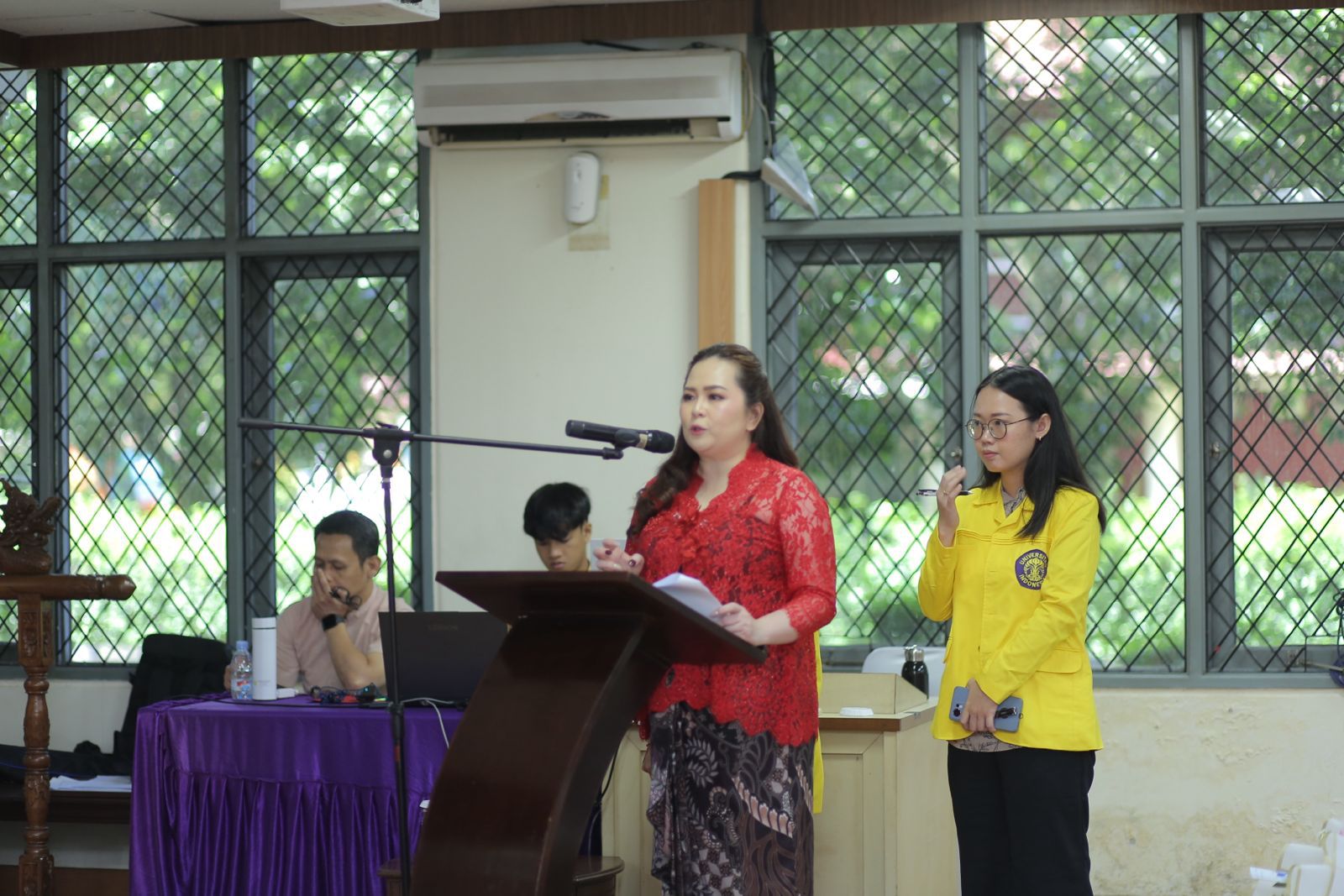
Depok, January 9, 2026 — The Faculty of Public Health, Universitas Indonesia (FPH UI), held an Open Doctoral Promotion Session for the Doctoral Program in Public Health Sciences on Friday (9/1). At the session, Chreisye Kardinalia Fransisca Mandagi successfully defended her dissertation entitled “Developing an Adaptive Policy for Complete Basic Immunization in Archipelagic Border Areas: A Case Study of the Sangihe and Talaud Islands Regencies.”
The dissertation highlights the persistently low coverage of Complete Basic Immunization (CBI) in archipelagic border regions, which is not solely attributable to individual or community behavioral factors, but is strongly influenced by structural and systemic challenges. Archipelagic geography, dependence on sea transportation, uncertainty in cold-chain logistics, and limited local decision-making space are identified as key factors hindering the stability of immunization services.
The study employed a mixed-method sequential explanatory approach, combining a quantitative survey of mothers of under-five children with qualitative methods, including in-depth interviews, observations, and document reviews involving cross-sectoral stakeholders. The findings show that socio-cultural factors have a significant influence on immunization status, while various individual-level variables alone cannot fully explain the low CBI coverage. These results underscore that immunization challenges in island regions are fundamentally issues of governance and service equity, rather than purely technical health problems.
As its primary scientific contribution, the dissertation produced the KAIL–KAIT–POLA 2.0 Adaptive Policy Model, a policy framework grounded in archipelagic governance. The model emphasizes contextual and flexible policymaking (KAIL), strengthened communication and cross-actor collaboration—including engagement with traditional and religious leaders (KAIT), and adaptive logistics protocols responsive to geographic conditions and extreme weather (POLA 2.0). This model is designed to bridge national policy frameworks with on-the-ground implementation realities in archipelagic border areas.
The dissertation’s promoter, Prof. Dr. Dra. Dumilah Ayuningtyas, M.A.R.S., stated that the KAIL–KAIT–POLA 2.0 model provides space for policy adaptation at the local government level without disregarding national policy frameworks. “This model is essential to ensure that immunization policies are implemented more effectively, equitably, and sustainably in regions facing significant geographic challenges,” she explained.
Meanwhile, Chreisye Kardinalia Fransisca Mandagi emphasized that the adaptive policy model is not intended to replace national policies. “Rather, it is expected to serve as a reference for both central and local governments in designing and implementing immunization services that are more flexible, collaborative, and aligned with the context of archipelagic border regions,” she noted.
The doctoral promotion session was chaired by Prof. Dr. drg. Wachyu Sulistiadi, M.A.R.S., with an examination committee comprising Prof. Dr. Dra. Dumilah Ayuningtyas, M.A.R.S. (Promoter); Prof. dr. Adang Bachtiar, M.P.H., D.Sc., and Dr. Puput Oktamianti, S.K.M., M.M. (Co-Promoters); as well as Dr. Dra. Rita Damayanti, MSPH.; Dr. dr. Maxi Rein Rondonuwu, DHSM., M.A.R.S.; Dr. dr. Harimat Hendarwan, M.Kes.; and Fajar Ariyanti, S.K.M., M.Kes., Ph.D. as examiners. Through this session, FPH UI once again reaffirmed its role in producing strategic research that contributes to strengthening the national health system, particularly for border and island regions.
Based on the successful defense of her dissertation, Chreisye Kardinalia Fransisca Mandagi was awarded the Doctoral degree in Public Health Sciences. She is recorded as the third graduate of the Doctoral Program in Public Health Sciences in 2026, the 375th graduate of the Doctoral Program in Public Health Sciences, and the 492nd doctoral graduate of FPH UI overall. (wrk)