

Depok, 3 November 2025 – As part of its commitment to strengthening international networks in research and community engagement, the Faculty of Public Health, Universitas Indonesia (FPH UI) welcomed a visit from Global Communities (GC), a U.S.-based nonprofit organization focused on improving global health and community well-being through sustainable cross-sector partnerships.
This visit marked an important momentum for FPH UI to reinforce its role as a global strategic partner in the development of public health research and interventions, particularly in the areas of maternal health, infant health, and community nutrition. During the meeting, FPH UI, GC, and the Yayasan Pembangunan Cita Insan Indonesia (YPCII) discussed the progress and future direction of their collaborative research on the Multiple Micronutrient Supplementation (MMS) program for pregnant women in Pandeglang District, Banten.
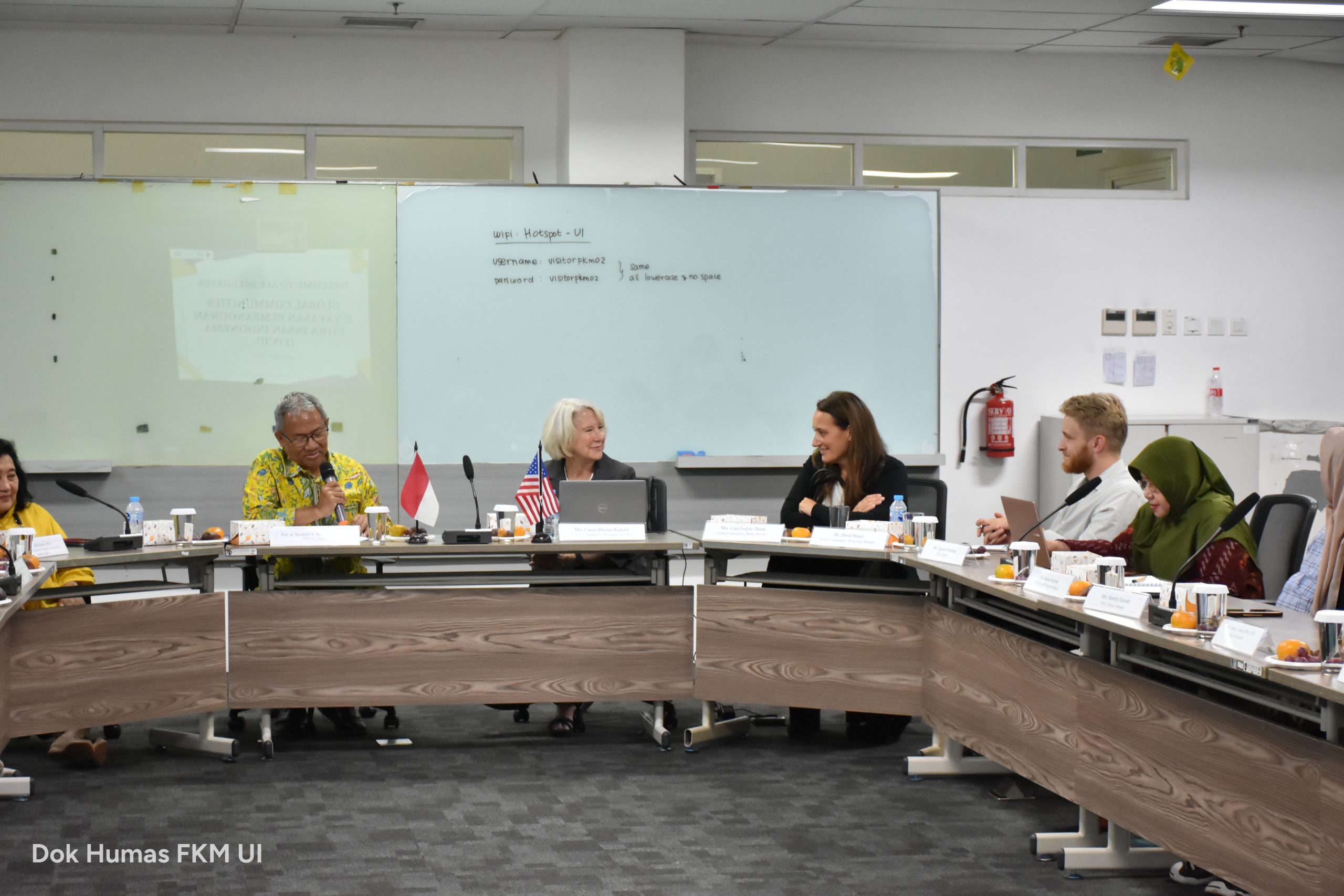
The meeting, held in Room PA 209, Building A, 2nd Floor, Health Sciences Cluster UI, was attended by faculty leaders, institutional representatives, and the Heads and Secretaries of Departments within FPH UI. From Global Communities, participants included Carrie Hassler Radelet (President and CEO of GC), Cara Endyke Doran (Senior Director, GC), David Mauer (Partnership Manager, GC), and Agustini Raintung (Director of YPCII), along with program donors and international advisors.
In her remarks, the Dean of FPH UI, Prof. dr. Mondastri K. Sudaryo, M.S., D.Sc., expressed her appreciation for the ongoing collaboration and her hope that the partnership will generate meaningful impact.
“Today’s meeting is highly significant for us. We extend our appreciation for this collaboration. We hope it will bring meaningful impact and open the door to impactful collaborations in the future,” said Prof. Mondastri.
Meanwhile, Carrie Hassler Radelet, President and CEO of Global Communities, emphasized the importance of global partnerships in expanding access to maternal and child health services.
“We are a nonprofit organization from the United States working to improve public health in various countries. I am truly delighted to return to UI after 30 years. This project is very special to me because of the many talented individuals involved in it,” she stated.
During her presentation, Cara Endyke Doran outlined Global Communities’ profile and strategic approach across four key areas: humanitarian assistance, global health, food systems, and financial inclusion. She highlighted that strong collaboration between the public and private sectors is essential to achieving real progress in global health. GC is currently implementing the MMS project in Pandeglang, Banten, as part of efforts to improve maternal nutrition and reduce stunting rates.
Representing YPCII, Agustini Raintung explained that Pandeglang was selected as the project location due to its high rates of maternal mortality, malnutrition, and immunization hesitancy. Through a continuum of family care model, YPCII is working with local governments to strengthen community health systems, particularly during the First 1000 Days of Life (HPK), by integrating antenatal, postnatal, and early childhood care services to support optimal development from pregnancy onward.
The Center for Family Welfare Research (PUSKA) FPH UI, represented by Trisari Anggondowati, S.K.M., M.Epid., Ph.D., delivered a presentation on the implementation study of MMS for pregnant women in Pandeglang. The research aims to assess the effectiveness of MMS distribution, community acceptance, and the social factors that influence the program’s success.
During the discussion session, participants shared diverse perspectives and experiences. Popy Yuniar, S.K.M., M.M., Ph.D., from the Department of Biostatistics, highlighted opportunities for methodological collaboration in community empowerment research and proposed organizing joint seminars to broaden knowledge impact. The discussion also underscored the importance of empowering midwives and local health workers to address behavioral barriers and strengthen knowledge and practice changes among rural pregnant women.
Prof. Endang L. Achadi added insights on the importance of aligning efforts with government programs—such as Posyandu—to reinforce maternal and child health interventions. Participants agreed that while the current project focuses on MMS, the issue is only one among many public health challenges that require multisectoral collaboration.
Both parties expressed hope that this partnership will continue and expand to other regions in Indonesia, aligning with FPH UI’s vision to serve as a global partner in fostering healthy, resilient, and empowered communities. (wrk)