

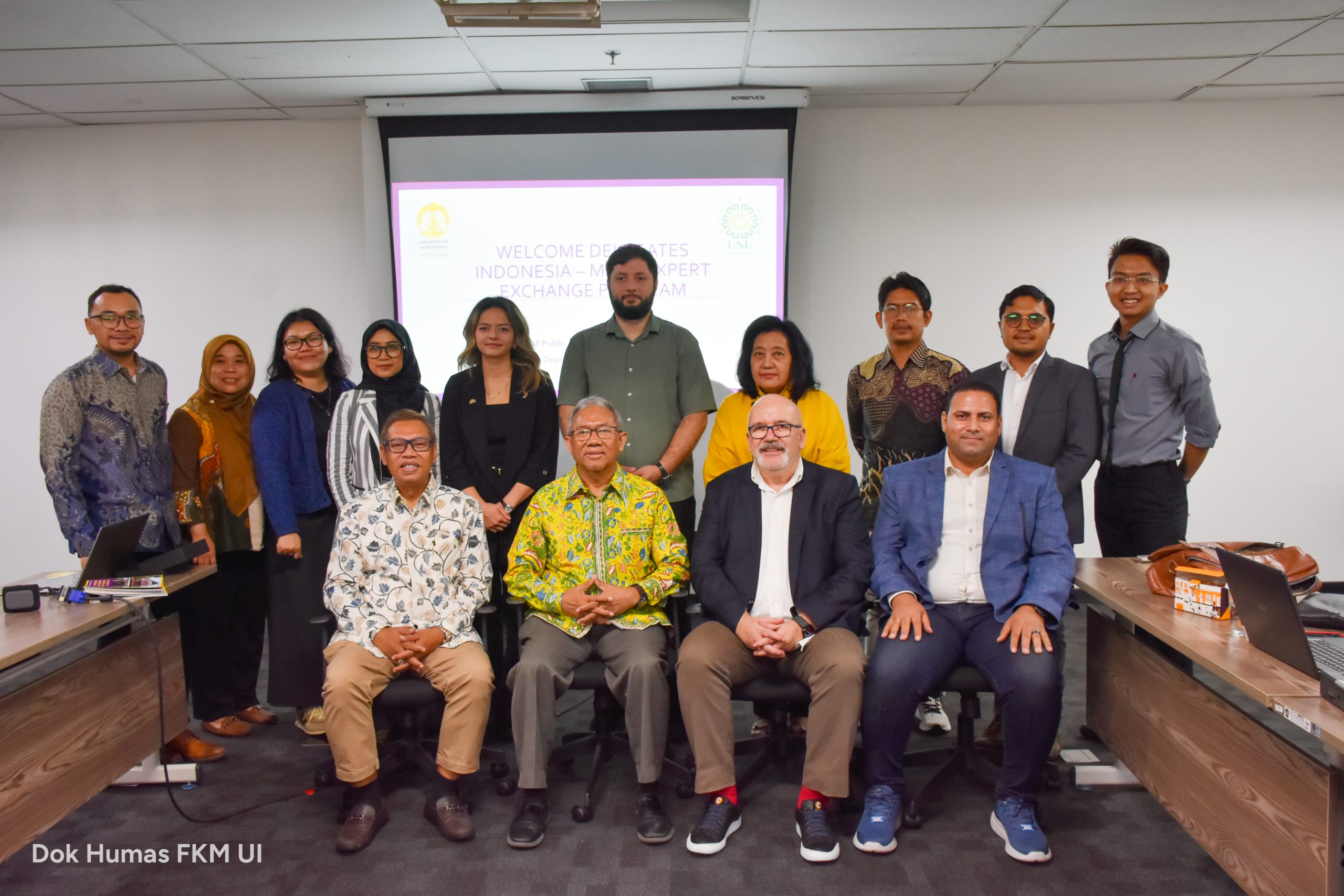
Depok, 3 November 2025 – The Faculty of Public Health (FPH) Universitas Indonesia (UI) once again demonstrated its leadership as a center of excellence in international collaboration on nutrition and public health. On Monday (3/11), at Meeting Room PA209, Health Sciences Cluster UI, FPH UI welcomed a delegation from the Indonesia–MENA Expert Exchange Program on Nutrition and Public Health, consisting of nutrition and public health specialists from Egypt and Turkey. This visit is part of a collaboration between Nahdlatul Ulama University (UNU) Yogyakarta and Danone Indonesia, supported by the British Council, to strengthen networks in research and innovation focused on stunting and anemia reduction.
The event was opened with remarks from the Dean of FPH UI, followed by discussions on recent developments in nutrition science in Indonesia—particularly strategies to reduce stunting and address anemia among mothers and children—along with key insights shared by experts from their respective institutions. The MENA delegation included Prof. Dr. Sarp Üner from Lokman Hekim University (Turkey), Duygu Güçlü from Bezmialem Vakıf University (Turkey), Dr. Abdelhamed Elshazly from Al-Azhar University (Egypt), and Elman Necefzade from GİMDES (Association for the Inspection and Certification of Food and Supplies) and Deputy Director of Daru’l Helal Medrese (Turkey). Representing FPH UI were the Dean, Prof. dr. Mondastri Korib Sudaryo, M.S., D.Sc.; Head of the Stunting Resource Center (SRC) FPH UI, Prof. dr. Endang L. Achadi, M.P.H., Dr.PH.; and Professor of Nutrition, Prof. Ir. Ahmad Syafiq.
During the discussion session, experts shared experiences and policies from their respective countries on integrating nutrition interventions into public health service systems. Indonesia—facing a stunting prevalence of 19.8% based on the 2024 Indonesian Nutritional Status Study (SSGI) and a high rate of anemia among children and women of reproductive age—encounters challenges similar to those faced by nations in the Middle East and North Africa. The forum explored insights that may inform evidence-based policy advocacy to strengthen Indonesia’s national nutrition system.
Public health expert Prof. Dr. Sarp Üner expressed admiration for FPH UI’s reputation in Indonesia’s health sciences landscape. “We understand that FPH UI is one of the strongest faculties in Indonesia in health sciences. The system here is different from Turkey, where public health sits under the medical faculty. Nonetheless, we are eager to learn from FPH UI’s experiences in addressing various public health issues. Despite the contextual differences, the public health challenges we face are actually quite similar,” he remarked.
Meanwhile, Dr. Abdelhamed Elshazly—an expert in food industry and health—highlighted the importance of integrating Islamic values with modern science in safeguarding community health. “Al-Azhar is the oldest Islamic educational institution in the world, and it has expanded into medicine, engineering, and food sciences to integrate religious values with scientific knowledge. In Islam, maintaining health is one of the primary goals. Nutrition plays a key role in sustaining human life. Therefore, humans must build a better future with a strong health environment. We truly appreciate the warm welcome from FPH UI, and we hope this collaboration will grow into a sustainable and impactful program,” he said.
Elman Necefzade emphasized the strong connection between halal consumption and public health. “Halal consumption is not only a religious concern; it is also a fundamental human right to consume pure and healthy food. We strive to promote public literacy on the importance of halal food through seminars and international conferences. Indonesia and Malaysia are key countries for expanding this awareness,” he noted.
From the field of nutrition science, Duygu Güçlü shared her research focus on adolescent health and nutrition education. She highlighted the importance of early education to instill healthy eating habits in children and encourage long-term behavioral change for better generational health.
Beyond knowledge exchange, the meeting also served as an opportunity to explore joint research collaborations between FPH UI and delegates from Egypt and Turkey in community nutrition, maternal and child health, and data-driven health policy.
During the response session, Prof. Dr. Endang L. Achadi, M.P.H., Dr.PH., connected the insights presented by the delegation with the strategic role of FPH UI through its Stunting Resource Center (SRC). She stressed opportunities for collaboration in stunting reduction, the First 1000 Days of Life focus, and the importance of ensuring halal quality not only in food but also in vitamins and supplements for maternal and child nutrition.
Furthermore, Prof. Ahmad Syafiq, who served as moderator, noted that the program opens significant opportunities for collaborative research in public health nutrition. “We need to develop a concrete plan to follow up on this collaboration, not only with Egypt and Turkey but also potentially with other countries. The forms of collaboration may include lecturer exchanges, student exchanges, and inter-institutional research,” he explained. “We aim to leverage this opportunity to establish research groups that will produce joint publications, research innovations, and real contributions to society,” he added.
This visit reaffirms FPH UI’s position as a leading academic and research hub for community nutrition in Indonesia, bridging science, policy, and practice. Through this meeting, FPH UI strengthens its commitment to building global partnerships that support the achievement of the Sustainable Development Goals (SDGs), particularly Goal 2 (Zero Hunger) and Goal 3 (Good Health and Well-Being).
Dean of FPH UI, Prof. dr. Mondastri Korib Sudaryo, M.S., D.Sc., emphasized that international collaboration is essential for accelerating solutions to complex multisectoral nutrition issues.
“This Indonesia–MENA Expert Exchange Program aligns with the spirit of FPH UI: Noble in Character, Excellent in Performance. Through knowledge exchange and cross-country collaboration, we not only strengthen academic capacity but also broaden the social impact of public health science. We believe that global synergy will accelerate Indonesia’s progress toward a healthier, more equitable, and empowered society. We hope this collaboration will lead to real programs that bring meaningful benefits to communities,” he stated.
This activity serves as an important first step toward long-term collaboration between Indonesia, Egypt, and Turkey in building a sustainable and equitable public health and nutrition system. (wrk)