


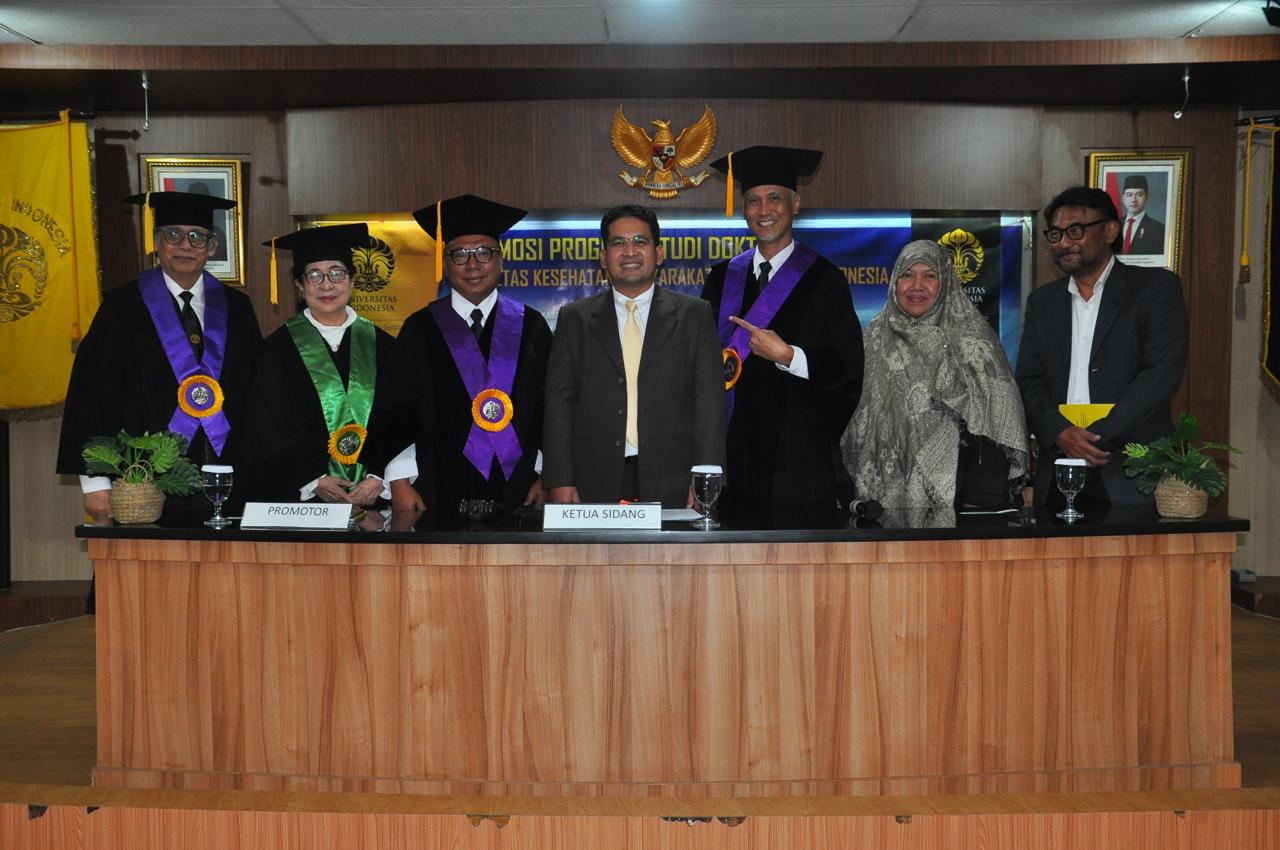
Depok, 17 November 2025 — The Faculty of Public Health (FPH), Universitas Indonesia (UI), once again held an Open Doctoral Promotion Session for the Doctoral Program in Public Health Sciences on behalf of Muhammad Syauqie on Wednesday, 17 December 2025, at the Doctoral Promotion Hall of FPH UI. In the session, the candidate successfully defended his dissertation entitled “Development of a Deep Learning Algorithm Model Based on Fundus Red Reflex Patterns for Screening Childhood Refractive Errors,” a study that offers a strategic breakthrough in the early detection of visual impairment among children.
The dissertation addresses a global public health challenge, namely the high burden of uncorrected refractive errors as a leading cause of visual impairment in children. This condition directly affects educational outcomes, productivity, and future quality of life. Through an interdisciplinary approach combining public health principles, artificial intelligence technology, and the use of digital devices, the research presents a screening solution that is more accessible, efficient, and has strong potential for large-scale implementation at the community level.
In his study, Muhammad Syauqie developed a deep learning algorithm model based on a Convolutional Neural Network (CNN) to analyze fundus red reflex patterns captured using a smartphone camera. The system is designed to detect and classify refractive errors in children, such as significant myopia and hypermetropia, without reliance on eye care specialists. The results demonstrated excellent model performance, with accuracy exceeding 90 percent, as well as high reliability between assessments conducted by non-specialists, such as teachers, and those performed by professional examiners.
Furthermore, field trials conducted in several primary schools showed that the model achieved promising sensitivity and specificity, particularly in detecting significant myopia among school-aged children. The study also assessed the acceptability and feasibility of using this technology in school settings. The findings indicate that the AI-based screening tool was well accepted by non-specialist users and considered feasible for implementation as part of child health screening programs.
The primary contribution of this dissertation lies not only in technological development, but also in its policy and health system implications. The AI-based screening model has the potential to support School Health Programs and primary health care services, especially in areas with limited access to eye health professionals. By engaging the education sector, community health centers, and local governments, this innovation can expand the coverage of early detection of refractive errors and accelerate timely referral and appropriate management.
The open doctoral session was chaired by Prof. Dr. drs. Tris Eryando, M.A. as Head of the Examination Committee, with Prof. Dr. Drs. Sutanto Priyo Hastono, M.Kes. serving as Promotor, and Prof. dr. Kemal N. Siregar, S.K.M., M.A., Ph.D. and Prof. Dr. dr. Nila F. Moeloek, Sp.M.(K) as Co-Promotors. The board of examiners also included Prasandhya Astagiri Yusuf, S.Si., M.T., Ph.D.; Dr. Eva Susanti, S.Kp., M.Kes.; Dr. dr. Lutfah Rif’ati, Sp.M.(K); and Dr. Joss Riono, M.Sc., M.P.H., Ph.D., Amd.RO, CMC.
Based on the successful defense of his dissertation, Muhammad Syauqie was declared to have passed and was awarded the degree of Doctor of Public Health Sciences. He is the 29th graduate of the Doctoral Program in Public Health Sciences in 2025, the 368th graduate of the program overall, and the 483rd doctoral graduate of FPH UI.
The successful doctoral promotion reflects FPH UI’s commitment to advancing research that responds to public health challenges, particularly through the use of digital technology and artificial intelligence to improve access to and quality of health services. Through doctoral graduates who generate impactful innovations, FPH UI continues to strengthen its position as a leading academic institution in the development of sustainable, inclusive, and community-oriented public health solutions. (wrk)