

Depok, February 4, 2026 — The Faculty of Public Health (FPH) Universitas Indonesia (UI) once again demonstrated its commitment to expanding academic collaboration networks by hosting a benchmarking visit from the Faculty of Health Sciences (FIK), Universitas Siliwangi, Tasikmalaya. The visit focused on curriculum development, accreditation strategies, and strengthening partnerships in community- and institution-based learning for the Environmental Health Study Program being developed by FIK Universitas Siliwangi.
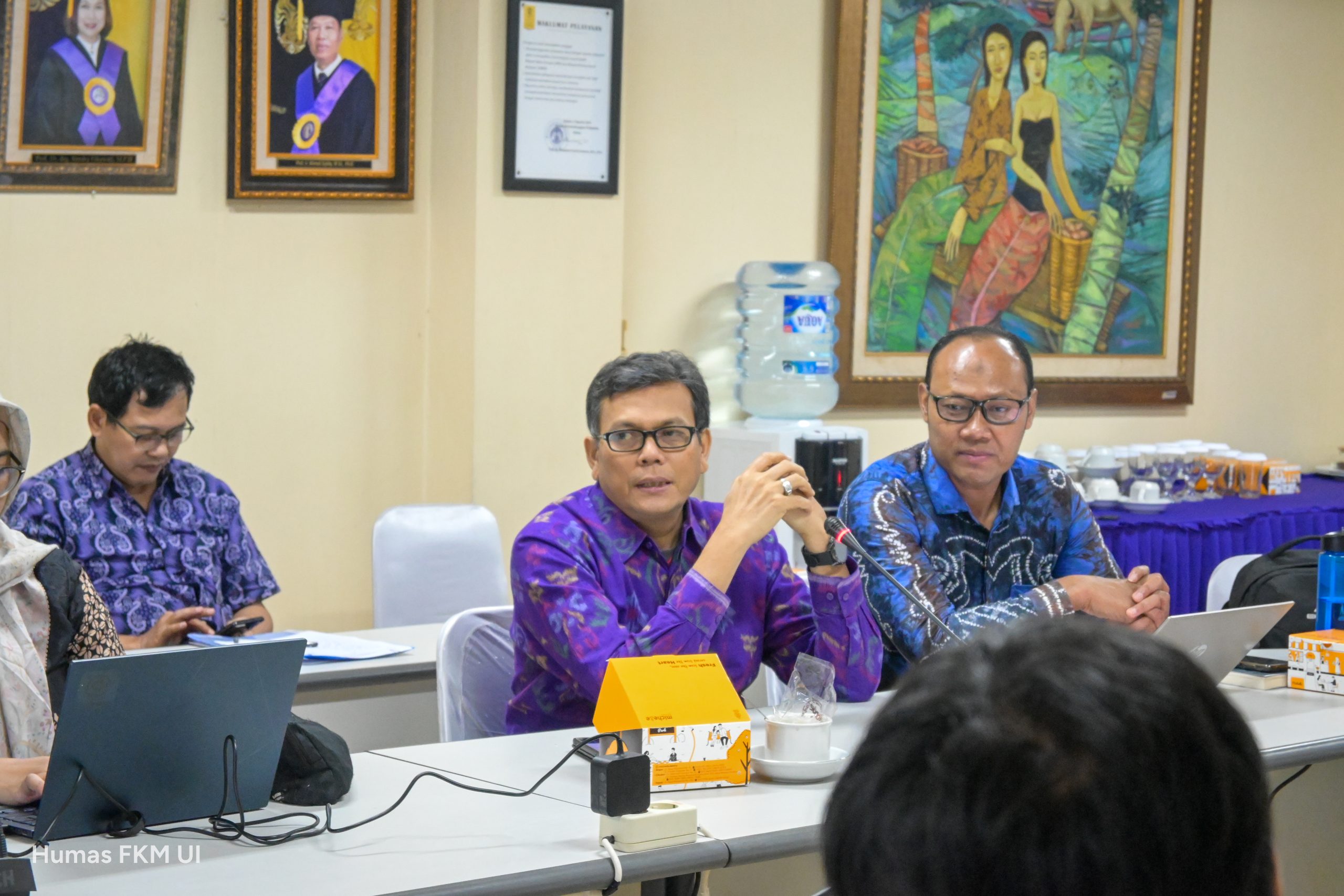
The meeting was held in the Professor’s Room, Building G, FPH UI, and was attended by the Vice Dean for Education, Research, and Student Affairs, Prof. Dr. Besral, S.K.M., M.Sc.; the Manager of Academic Affairs, Student Affairs, Alumni, and Internationalization, Dr. Laila Fitria, S.K.M., M.K.M.; the Head of the Department of Environmental Health, Dr. Zakianis, S.K.M., M.K.M.; along with faculty leaders and lecturers from the Department of Environmental Health at FPH UI. The delegation from Universitas Siliwangi included faculty leaders, the Environmental Health Study Program development team, as well as lecturers and academic staff involved in curriculum planning and learning partnerships.
In his remarks, Prof. Dr. Besral emphasized the importance of inter-university collaboration in addressing increasingly complex environmental health challenges. “A curriculum should not be developed in isolation. It must be grounded in the real needs of society, industry, and policy,” he stated.
The discussion centered on the undergraduate Environmental Health curriculum at FPH UI, covering curriculum structure, intended learning outcomes, teaching strategies, and the integration of theoretical and field-based learning. The Department of Environmental Health explained that the curriculum is developed based on international benchmarking, stakeholder input, and continuous evaluation. It is also aligned with the latest accreditation standards, which emphasize evidence-based self-evaluation (Self-Evaluation Report/SER). Learning is not limited to classroom settings but is strengthened through Field Learning Practice (PBL), implemented through both community-based and institution-based schemes, as well as partnerships with various sectors, including industry, local government, and professional organizations.
During the discussion session, the FIK Universitas Siliwangi team actively raised questions and shared challenges in curriculum development. They explained that they are currently refining their Environmental Health Study Program curriculum and are seeking best practices, particularly in integrating learning outcomes, designing teaching strategies, and aligning education with labor market needs. They also highlighted challenges in establishing partnerships with field institutions and balancing student interests between industry and government sectors.
In response, the Head of the Department of Environmental Health, Dr. Zakianis, outlined strategies for strengthening partnerships through alumni engagement as a bridge to institutional collaboration. He noted that alumni involvement has proven effective in opening access to field practice sites and enhancing the quality of students’ learning experiences. “We intentionally involve alumni as connectors because they understand field needs while also representing the institution,” he explained.
In the accreditation session, FPH UI shared its experience in preparing curriculum documents and the SER, emphasizing that supporting evidence and performance indicators are key to successful accreditation. Limitations in facilities and infrastructure, they noted, can be addressed through partnerships with external laboratories or collaborating institutions.
The Universitas Siliwangi delegation expressed appreciation for the discussion, noting that the visit provided concrete insights into curriculum development aligned with workforce needs. They also gained valuable perspectives on managing faculty-to-student ratios, partnership strategies, and continuous evaluation mechanisms.
The visit concluded with an agreement to continue communication and explore further collaboration opportunities, including the exchange of best practices, joint research, and strengthened academic partnerships in the field of environmental health. (EAR)