


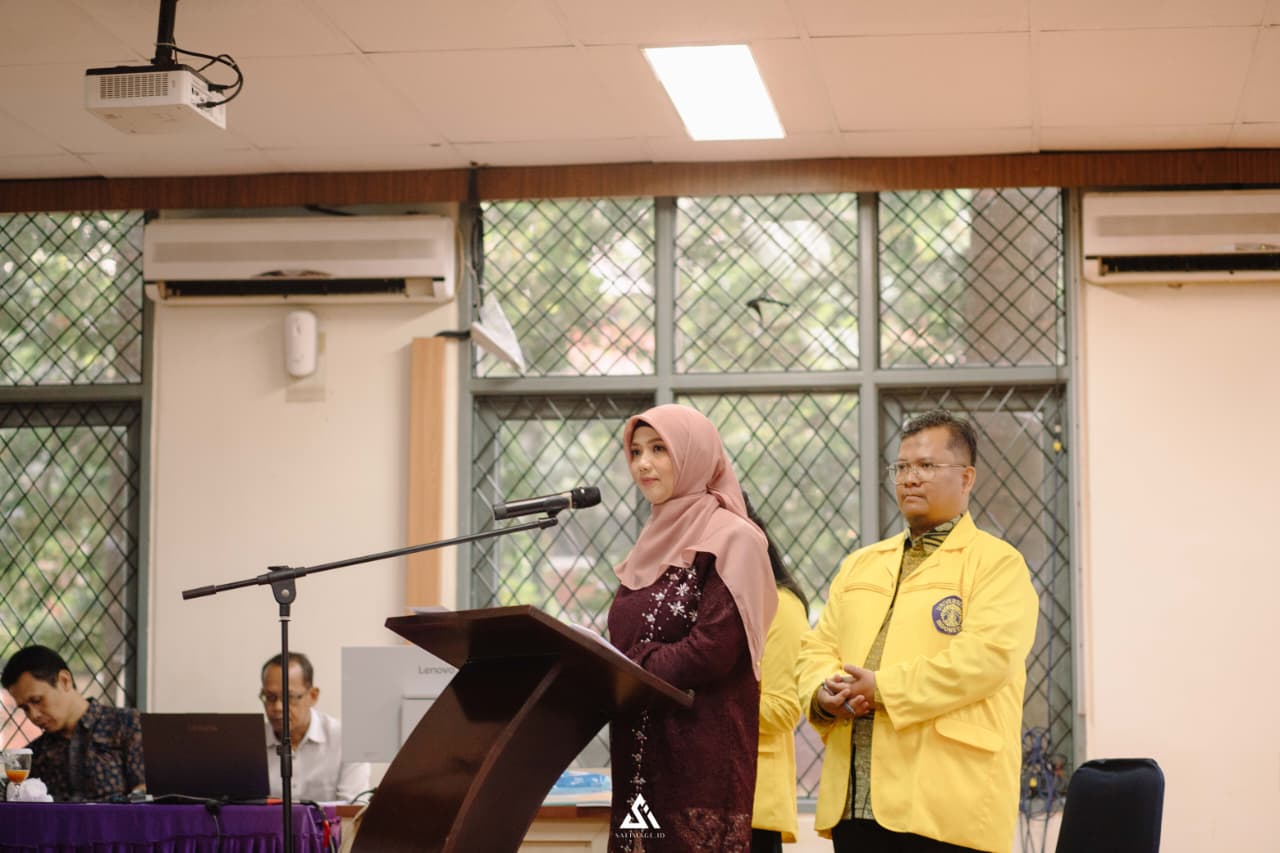
Depok, June 27, 2026 – Public health research has received a boost through a new research-based innovation from Universitas Indonesia. The innovation was presented at an open doctoral promotion examination held at the FPH UI campus in Depok. During the examination, Dian Nur Hadianti successfully defended her dissertation, which developed a machine learning-based prediction model to increase family planning (FP) participation among Generation Z at the community level. This research offers a new approach to supporting the digital transformation of family planning services in Indonesia through the use of artificial intelligence (AI).
The dissertation, entitled “Machine Learning-Based Prediction Modeling to Increase Family Planning Participation Among Generation Z and Develop a Super App Prototype for Family Planning Officers,” was motivated by the relatively low modern contraceptive prevalence rate (MCPR) among women of reproductive age (WRA) belonging to Generation Z compared with national targets. The low uptake of modern contraception is influenced by various factors, including limited knowledge, attitudes toward contraception, and access to family planning information and services. Meanwhile, Generation Z, as a group of digital natives, requires healthcare services that are more responsive to technological developments.
Using a sequential explanatory mixed-methods approach, Dian developed a prediction model that integrates statistical analysis, machine learning, user needs assessment, prototype development, and field implementation testing. The study produced not only a prediction model but also a web-based super app called Dplan KB, designed as a decision support system for family planning officers to deliver more targeted services to Generation Z.
The initial stage of the research identified various factors influencing family planning participation through a systematic literature review. Subsequently, using data from the 2017 Indonesia Demographic and Health Survey (IDHS), the study identified nine key predictors of modern contraceptive use among Generation Z: number of living children, fertility status, wealth quintile, support from healthcare workers, literacy skills, fertility knowledge, wife’s education, cohabitation with a partner, and visits by family planning officers. The number of living children emerged as the most influential factor in modern contraceptive use.
One of the study’s key findings was the successful application of a Neural Network algorithm, which outperformed five other algorithms to become the best-performing prediction model. The model achieved an Area Under the Curve (AUC) of 0.859, an accuracy of 83.9%, a precision of 84.3%, and an F1-score of 0.838. These results indicate strong classification performance and suggest that the model is suitable for predicting family planning participation among Generation Z.
The prediction model was subsequently integrated into the Dplan KB prototype, a super app featuring family planning participation prediction, reproductive health education, contraceptive use screening, teleconsultation, service recordkeeping, visit reminders, and contraceptive planning. Compared with conventional service delivery systems, the application can accelerate target population identification, facilitate education, and support data-driven decision-making by family planning officers.
Field trials showed that the Dplan KB prototype was very well received by both family planning officers and Generation Z participants. Its use significantly improved officers’ performance, knowledge, and attitudes compared with the control group. In addition, the application increased Generation Z participants’ satisfaction with and positive attitudes toward family planning services, while also encouraging greater use of modern contraception among participants in the intervention group.
This study introduces several innovations compared with previous research. It is the first prediction model in Indonesia specifically developed to predict family planning participation among married members of Generation Z. It also integrates a public health approach with machine learning technology into a digital system that can be used directly by family planning officers at the community level. The model is designed not merely as a prediction tool but also as an early detection system, a mobile health solution, and a decision support system. It has the potential to be integrated into the digital ecosystem of the National Population and Family Planning Board (BKKBN), including the Super Apps Keluarga Indonesia and the Family Information System (Sistem Informasi Keluarga or SIGA).
In practical terms, the findings offer a strategic contribution to strengthening family planning services in Indonesia. Dplan KB has the potential to help the government expand modern contraceptive use, improve the quality of services provided by family planning officers at the community level, support more effective family planning, and contribute to better maternal and child health outcomes while optimizing the country’s demographic dividend.
Dian Nur Hadianti’s doctoral promotion examination was chaired by Prof. Dr. Drs. Sutanto Priyo Hastono, M.Kes., as Chief Examiner. Prof. dr. Kemal N. Siregar, M.A., Ph.D., served as the dissertation promoter, with Prof. Dr. Drs. Tris Eryando, M.A., and Dr. Sudibyo Alimoeso, M.A., as co-promoters. The examination committee comprised Prof. dr. Anhari Achadi, S.K.M., Sc.D.; Dr. Mila Herdayati, S.K.M., M.Si.; Dr. Indrajani, S.Kom., M.M.; and Pungkas Bahjuri Ali, S.TP., M.S., Ph.D.
This research further strengthens FPH UI’s role as a higher education institution that produces research-based innovations to address public health challenges through digital technology. The development of this machine learning-based prediction model demonstrates FPH UI’s commitment to delivering solutions that are not only academically excellent but also ready for implementation to support public health policies and services in Indonesia. (wrk)