


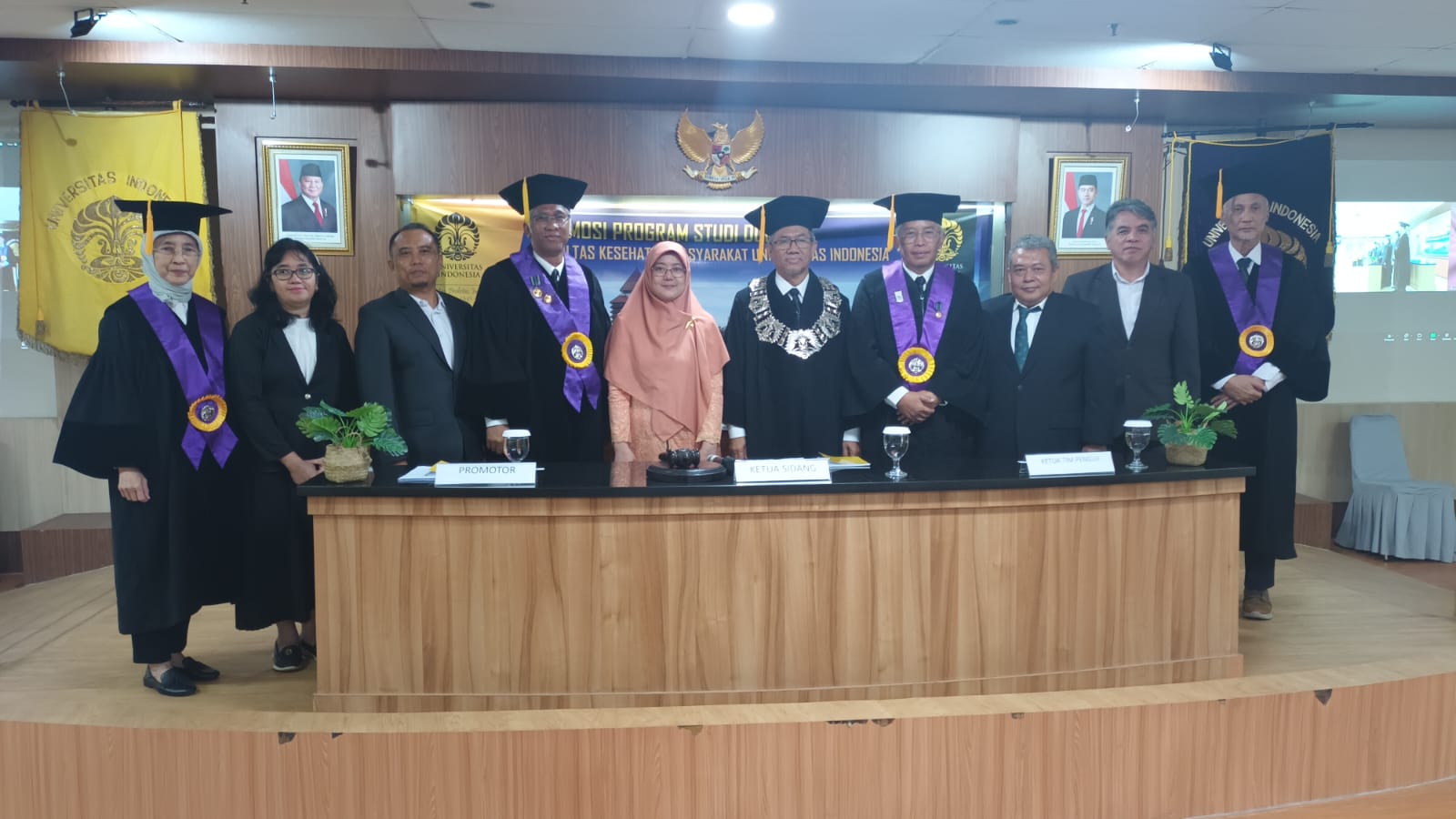
Depok, 25 November 2025 — The Faculty of Public Health (FPH), Universitas Indonesia, once again held an Open Doctoral Promotion Session for the Doctoral Program in Public Health Sciences on behalf of Khadijah Azhar. In the session, which took place on 25 November 2025 at the Doctoral Promotion Hall of FPH UI, Khadijah successfully defended her dissertation entitled “A Climate-, WASH-, and Regional Characteristics–Based Diarrhea Risk Prediction Model According to Rainy Season Zones in Indonesia (Data Analysis 2017–2021).”
The dissertation addresses a strategic public health issue, namely diarrheal disease as an environmentally based illness that remains a major challenge in Indonesia, particularly in the context of climate change. Using an ecological approach and cross-sectoral data analysis, the study integrates climate variables (rainfall, temperature, and humidity), water, sanitation, and hygiene (WASH) factors, as well as regional and socioeconomic characteristics to develop a diarrhea risk prediction model that is adaptive to differences across rainy season zones.
The research was conducted comparatively in two regions with distinct climatic characteristics, namely West Nusa Tenggara Province (monsoonal zone) and West Sumatra Province (equatorial zone), utilizing secondary data from 2017–2021 obtained from the Ministry of Health, Statistics Indonesia (BPS), and the Meteorology, Climatology, and Geophysics Agency (BMKG). The analysis employed negative binomial regression to generate a more accurate prediction model for count data on diarrhea incidence that exhibit overdispersion.
The findings demonstrate that climate variability contributes to diarrhea risk with differing patterns across regions. Rainfall was found to be significantly associated with diarrhea incidence in both provinces, although the direction of the relationship differed. WASH factors—particularly limited access to safe drinking water and inadequate sanitation—consistently emerged as key determinants of increased diarrhea risk. Meanwhile, socioeconomic factors such as poverty played a significant role in certain regions, further reinforcing community vulnerability to environmentally based diseases.
The dissertation also produced a region- and rainy season zone–based diarrhea risk prediction model that showed good performance with low to moderate accuracy levels. The model holds potential for further development as part of an adaptive early warning system for diarrheal diseases in the context of climate change. It is expected to support more targeted, data-driven, and cross-sectoral public health intervention planning.
The open doctoral session was chaired by Prof. Dr. Budi Haryanto, S.K.M., M.Kes., M.Sc. as Head of the Examination Committee, with Prof. Drs. Bambang Wispriyono, Apt., Ph.D. serving as Promotor, and Prof. Dr. drg. Ririn Arminsih, M.Kes. and Dr. Dwi Hapsari Tjandrarini, S.K.M., M.Kes. as Co-Promotors. The board of examiners also included Prof. Dr. drs. Tris Eryando, M.A.; Dr. Budi Hartono, S.Si., M.K.M.; Dr. Miko Hananto, S.K.M., M.Kes.; and Dr. Dede Tarmana, S.Si., M.Si.
Based on the successful defense of her dissertation, Khadijah was declared to have passed and was awarded the degree of Doctor of Public Health Sciences. She is the 26th graduate of the Doctoral Program in Public Health Sciences in 2025, the 365th graduate of the program overall, and the 480th doctoral graduate of FPH UI.
Through this achievement, FPH UI once again affirms its commitment to producing doctoral graduates who are not only academically excellent, but also capable of providing scientific solutions to national and global public health challenges. Khadijah Azhar’s dissertation stands as tangible evidence of FPH UI’s contribution to the advancement of public health science that is responsive to the challenges of climate change and sustainable development. (wrk)