

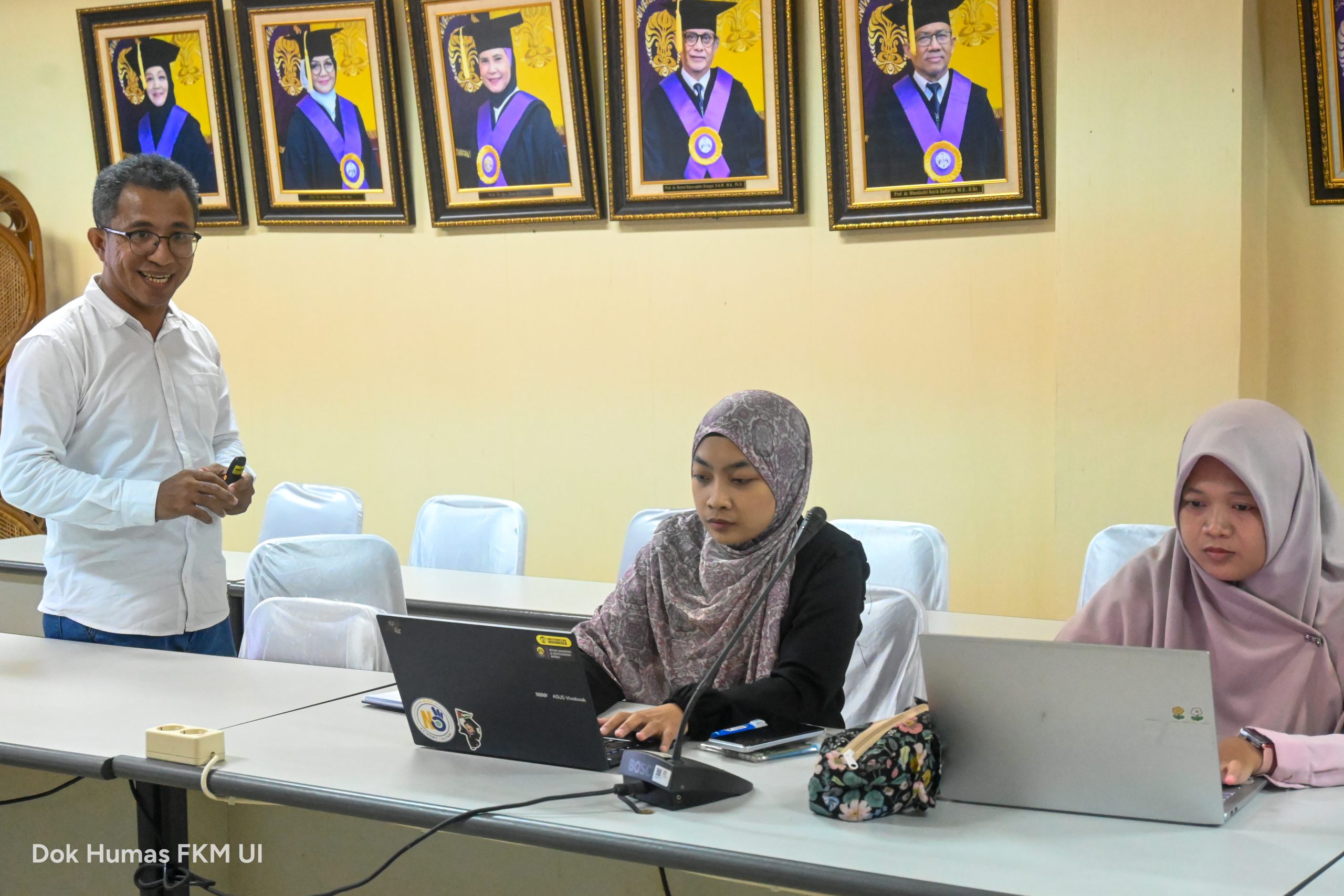
Depok, 18 November 2025 — The Faculty of Public Health (FPH) Universitas Indonesia (UI) held a training session on the preparation of Social Return on Investment (SROI) reports for lecturers and teams receiving the 2025 Community Engagement and Empowerment (PPM) Grant. The training, conducted in the Professors’ Lounge of FPH UI, featured Yosef Hilarius Timu Pera, S.Sos., M.Si., Lecturer at the Department of Sociology, Faculty of Social and Political Sciences (FISIP) UI, as the main speaker. The session focused on enhancing the academic community’s capacity to measure social impact in a more systematic, structured, and evidence-based manner.
In her remarks, Vice Dean for Education, Research, and Student Affairs of FPH UI, Dr. Ir. Asih Setiarini, M.Sc., emphasized the importance of more comprehensive impact evaluation in public health. “We are not only required to look at program outputs but also at broader social benefits, the economic value created, and the long-term changes experienced by communities. SROI provides a structured and evidence-based approach to capture these aspects. This workshop is essential for strengthening our capacity as program planners and evaluators,” she stated.
In his presentation, Yosef Hilarius explained the fundamental concepts and detailed techniques for calculating SROI. He highlighted that SROI is an evaluation method capable of showing whether a program truly generates impact, who benefits from it, and whether the benefits created are proportional to the investment made. “We often measure success only by the implementation of activities. However, what matters most is the actual change felt by the community. SROI helps us map and assess these changes more comprehensively and objectively,” he explained.
Yosef further emphasized the strengths of SROI as a method that can identify wide-ranging impacts, involve stakeholders in the evaluation process, and quantify benefits using both qualitative and quantitative approaches. “SROI is not just about numbers; it’s about understanding the story of change behind a program. Through this approach, we can see how even small interventions may produce significant social value,” he added.
In the next session, Yosef outlined the six stages of SROI analysis, which include defining the scope, identifying stakeholders, mapping outcomes, determining impact, evidencing and valuing outcomes, and calculating the SROI ratio. Participants were introduced to various financial valuation methods, including market-based proxies, stated preference, and revealed preference. He emphasized the importance of validating impact values by considering factors such as deadweight, attribution, displacement, and drop-off to ensure accuracy. “We must be honest in assessing how much change is truly attributable to our program, not accidental or influenced by other factors. This is where SROI teaches us to avoid overclaiming,” he stressed.
Through real case examples, participants learned how to conduct comprehensive impact mapping that leads to the calculation of an SROI ratio reflecting the social value generated by a program. This approach not only strengthens lecturers’ community engagement reports but also enhances accountability to stakeholders.
The implementation of this training reaffirms FPH UI’s commitment to fostering a culture of evidence-based community engagement that prioritizes long-term impact. With improved SROI reporting skills, lecturers are expected to design more relevant, effective programs that produce measurable social value. This initiative further solidifies FPH UI’s position as an institution that consistently promotes transparent, responsible, and impact-oriented governance in community engagement programs. (wrk)