

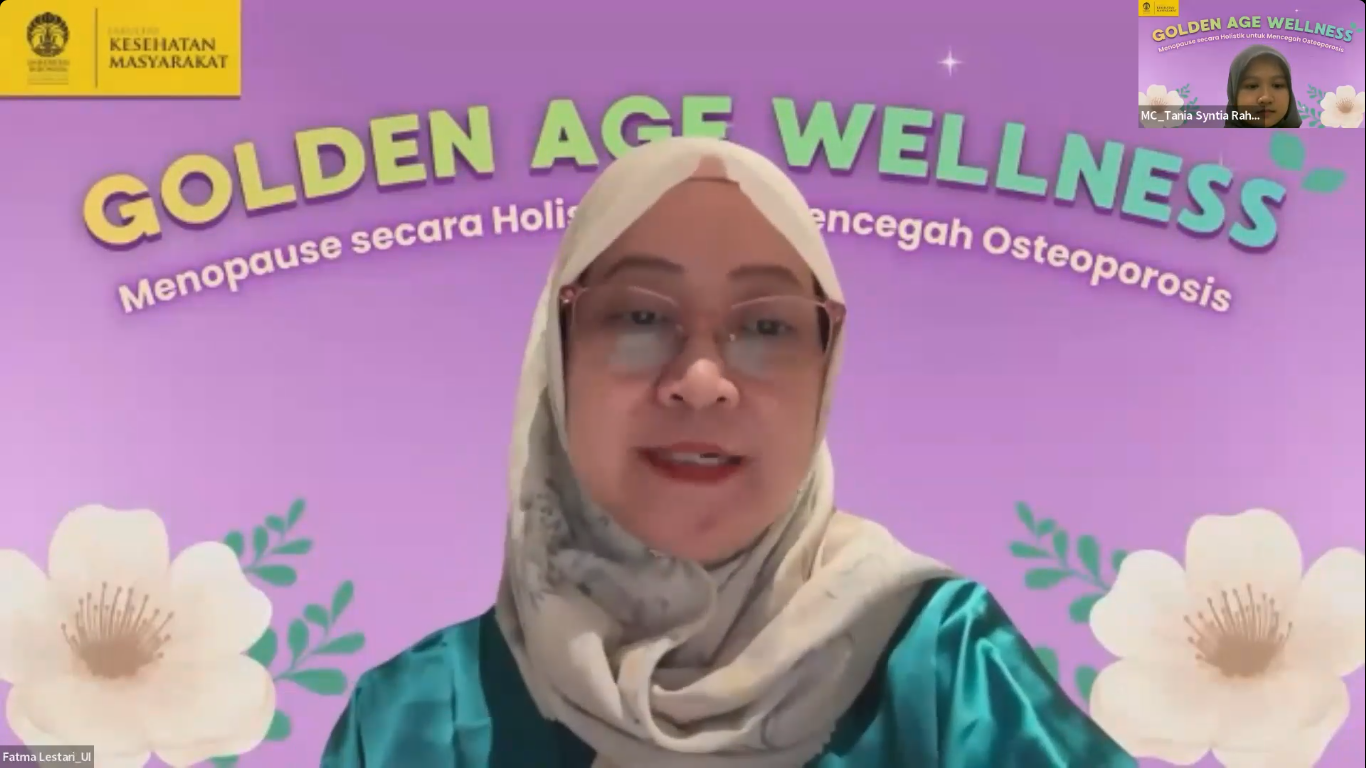
Monday, December 1, 2025 — The Faculty of Public Health (FPH), Universitas Indonesia (UI), held the Online Seminar (Semol) Series 13 titled “Golden Age Wellness: Holistic Preparation for Menopause to Prevent Osteoporosis” in a hybrid format. The seminar served as an interactive discussion forum addressing women’s reproductive health, particularly in facing menopause through a holistic and preventive approach, featuring speakers from academia and professional practice.
Prof. Fatma Lestari, S.Si., M.Si., Ph.D., Chair of the Board of Professors of FPH UI for the 2025–2030 period, delivered the opening remarks and outlined the objectives of the seminar. “This activity reflects our commitment to improving the quality of life of Indonesian women. The high prevalence of osteoporosis in Indonesia indicates that this issue is not merely a medical problem, but also one related to independence, quality of life, and elderly well-being. I hope this webinar becomes a valuable platform for knowledge sharing and raises awareness that menopause is a phase toward a new balance that can be experienced in a healthy and meaningful way,” she stated.
Prof. Dr. dr. Ella Nurlaella Hadi, M.Kes., from the Reproductive Health Study Group and Professor at FPH UI, also conveyed her expectations for the implementation of Semol Series 13. “The purpose of this webinar is to increase public knowledge, understanding, and awareness—especially among women—about the importance of holistic preparation for menopause in order to prevent osteoporosis. We hope that the presentations delivered by the three speakers will enhance knowledge so that osteoporosis can be prevented,” said Prof. Ella.
Semol Series 13 was moderated by Prof. Dr. drg. Indang Trihandini, M.Kes., Chair of the Board of Professors for the 2020–2025 period and a faculty member of the Reproductive Health Study Group at FPH UI. The first presentation was delivered by Dr. dr. Helda, M.Kes., Head of the Master’s Program in Epidemiology, on “Physiological and Hormonal Changes During Menopause and Their Relationship to Bone Health.” She explained that menopause is often perceived as the end of the reproductive phase, while older age is frequently associated with decline. However, various studies and programs demonstrate that both phases can instead serve as opportunities to optimize quality of life through holistic support—hormonally, physically, mentally, and socially within the community.
“The most significant change faced by women entering the age of 45–55 is menopause, defined as the cessation of menstruation for 12 consecutive months. This phase is marked by a drastic decline in estrogen levels,” explained Dr. Helda. “This decline not only triggers vasomotor symptoms such as hot flashes and night sweats, but also affects other body systems.” She further emphasized that comprehensive prevention should begin early, as peak bone mass must be built before the age of 30. “After menopause, it is important to ensure adequate intake of calcium and vitamin D, including through local foods such as tofu, tempeh, and fish, as well as early detection using tools such as FRAX (Fracture Risk Assessment Tool),” she concluded.
The second presentation was delivered by Dr. Asti Widihastuti, MHC., a Public Health Practitioner at UNFPA Indonesia, who discussed the relationship between menopause and mental health. She emphasized that menopause should not be viewed solely as a biological event, but also as an issue of population health, economics, and equity—an approach aligned with the principles promoted by UNFPA (United Nations Population Fund).
“Hormonal fluctuations during the perimenopausal phase greatly affect mental and emotional well-being, often leading to mood disturbances, anxiety, depression, and difficulty concentrating,” explained Dr. Asti. “UNFPA emphasizes that menopause is not merely a personal health issue, but a population health, economic, and equity issue. Therefore, it requires a multisectoral approach focused on equity, including addressing social isolation, ensuring economic security, and reducing stigma.”
The third speaker, Dr. drg. Maria Margaretha, M.Si., FISQua, Head of the Social Rehabilitation Division at the DKI Jakarta Provincial Social Service, presented on the crucial role of social and community support in improving the quality of life of the elderly. In DKI Jakarta, such support is realized through residential care services as well as assistance provided outside institutional settings.
“The DKI Jakarta Provincial Social Service manages the Tresna Werdha Budi Mulia Social Home, which provides comprehensive services for elderly Social Assistance Beneficiaries. These services include healthcare, social assistance, and fulfillment of basic needs. In addition, we also provide social support outside residential care through social rehabilitation programs, such as the Jakarta Elderly Card (Kartu Lansia Jakarta/KLJ), which provides direct financial assistance of IDR 300,000 per month to support basic needs, as well as ABF assistance in the form of physical aids such as wheelchairs and white canes through district social service offices,” explained Dr. Maria, highlighting the commitment of the DKI Jakarta Social Service to supporting elderly women.
As an institution committed to the development of public health sciences and the improvement of the quality of life of the Indonesian population, FPH UI views Semol Series 13 as an important part of its ongoing efforts to strengthen health literacy among elderly women. Through cross-disciplinary collaboration, evidence-based scientific presentations, and engagement with stakeholders at the academic, governmental, and international organizational levels, FPH UI continues to reinforce its role in promoting more inclusive and holistic policies and practices. This seminar is expected not only to broaden understanding, but also to stimulate concrete actions in preparing Indonesian women to face menopause in a healthy, independent, and dignified manner. Seminar materials and recordings can be accessed at fkmui.ui.ac.id. (ITM)