


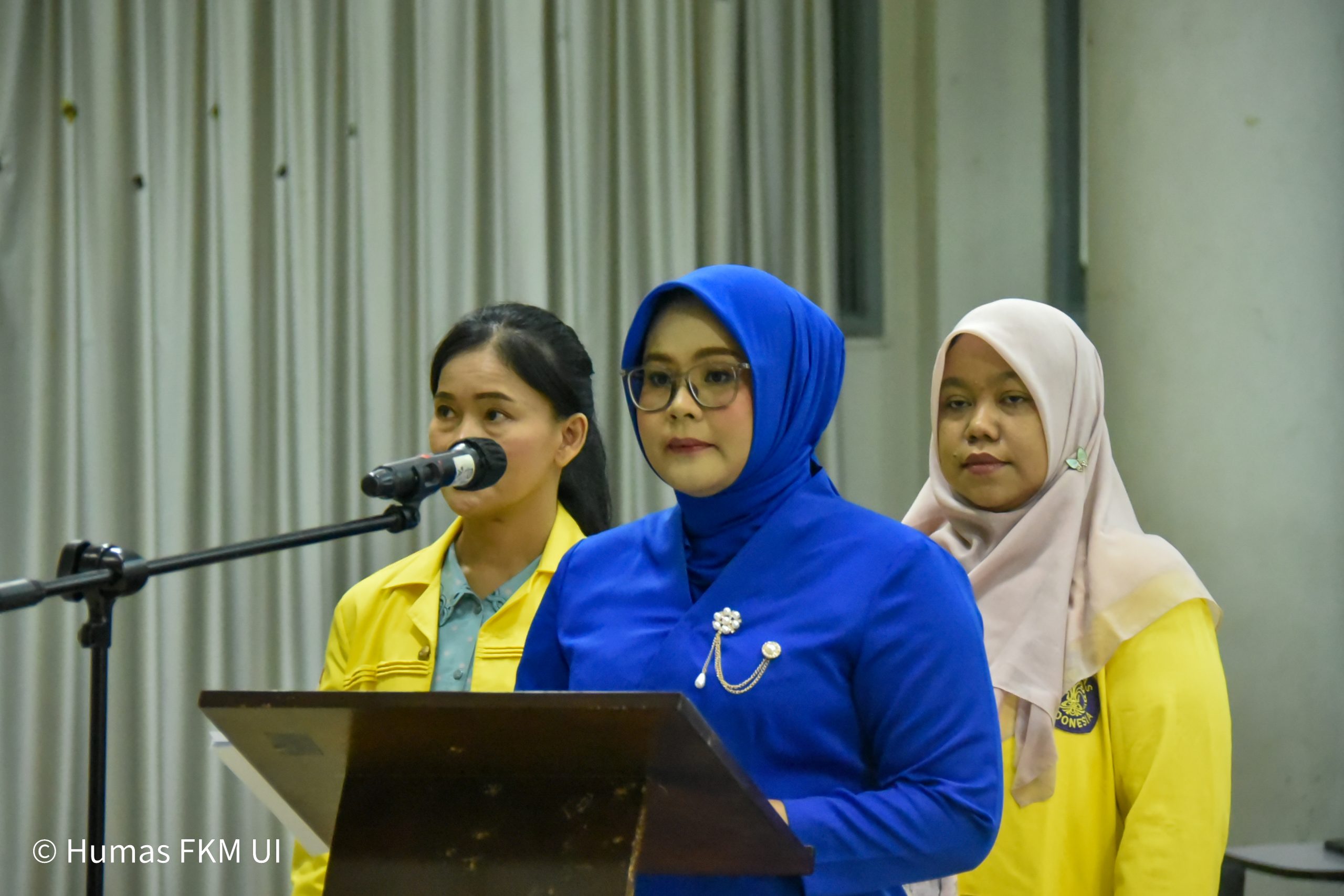
Depok, June 29, 2026 – The Faculty of Public Health, Universitas Indonesia (FPH UI), has welcomed another doctoral graduate whose research contributes to the advancement of data-driven public health science. During the open doctoral promotion examination held by the Doctoral Program in Public Health Sciences, Restu Octasila successfully defended her dissertation, which explores the use of machine learning to predict infant survival in Indonesia through a more precise approach that accounts for regional characteristics.
Restu’s research, entitled “Prediction and Projection of Infant Survival Using Machine Learning Based on Provincial Clustering,” addresses persistent disparities in infant mortality rates across Indonesia. Although the national Infant Mortality Rate (IMR) continues to decline, regional inequalities remain a major challenge in achieving health development targets. In response, Restu developed a predictive model designed not only to identify risk factors for infant mortality but also to project the effects of various policy intervention scenarios with greater accuracy.
The study used data from the 2017 Indonesian Demographic and Health Survey (IDHS), covering 13,553 infants from 34 provinces across Indonesia. Through five research stages—comprising a systematic literature review, survival analysis, regional clustering using the K-Modes algorithm, machine learning model development, and policy projection simulations—the study introduced a new approach to mapping infant mortality risks based on the characteristics of individual regions.
The findings identified six major determinants of infant survival in Indonesia: birth weight, adequacy of antenatal care (ANC) visits, parity, birth spacing, maternal age at delivery, and maternal occupation. One notable finding was that infants without recorded birth weight had a higher risk of death than infants with low birth weight. This suggests that the absence of birth weight records may reflect limited access to adequate healthcare services during childbirth.
As its main innovation, the study grouped Indonesian provinces into two clusters based on the characteristics of health determinants. The first cluster was dominated by provinces facing challenges related to healthcare service quality, while the second comprised provinces that continued to face barriers to healthcare access and basic infrastructure. This approach demonstrates that a uniform national policy may not be equally effective across all regions of Indonesia, highlighting the need for intervention strategies tailored to the specific characteristics of each area.
In developing the predictive model, Restu compared nine machine learning algorithms. The results showed that Light Gradient Boosting Machine (LightGBM) delivered the best performance in both clusters, achieving an area under the curve (AUC) of 0.94 and high sensitivity in identifying infants at risk. The model was considered capable of producing more accurate predictions than conventional statistical approaches, making it a promising tool for early risk screening in maternal and child health services.
The study also simulated various policy intervention scenarios. The projections indicated that improving the nutritional status of pregnant women to reduce the incidence of low birth weight, strengthening antenatal care services, expanding protections for working mothers, and reinforcing family planning programs could increase infant survival probabilities while reducing regional disparities across Indonesia.
Beyond its methodological contribution through the integration of survival analysis, clustering, and machine learning, the study offers practical policy recommendations. At the national level, the model is recommended for integration into the SATU SEHAT platform as an automated risk-screening system beginning with the first antenatal visit. At the regional level, local governments could use the findings to develop subdistrict-level risk maps, enabling more targeted maternal and child health interventions.
The doctoral promotion examination was conducted before an examination committee chaired by Dr. Mila Herdiyati, S.K.M., M.Si., with members Prof. Dr. Drs. Tris Eryando, M.A.; Dr. Soedibyo Alimoeso, M.A.; Dr. dr. Teti Tejayanti, M.K.M.; Dr. Ade Jubaedah, S.SiT., M.M., M.K.M.; Dr. Ariyanto Nugroho; and Dr. Laode Muhammad Rasidi Rere. Restu Octasila completed her dissertation under the supervision of Prof. Dr. Besral, S.K.M., M.Sc., as Promoter, and Prof. dr. Kemal Nazaruddin Siregar, S.K.M., M.A., Ph.D., as Co-Promoter.
Through this achievement, FPH UI reaffirms its commitment to producing high-quality research that not only advances scientific knowledge but also offers innovative solutions to public health challenges. The application of machine learning in this study is expected to support the transformation of Indonesia’s healthcare system toward services that are more predictive, targeted, and evidence-based. (wrk)