


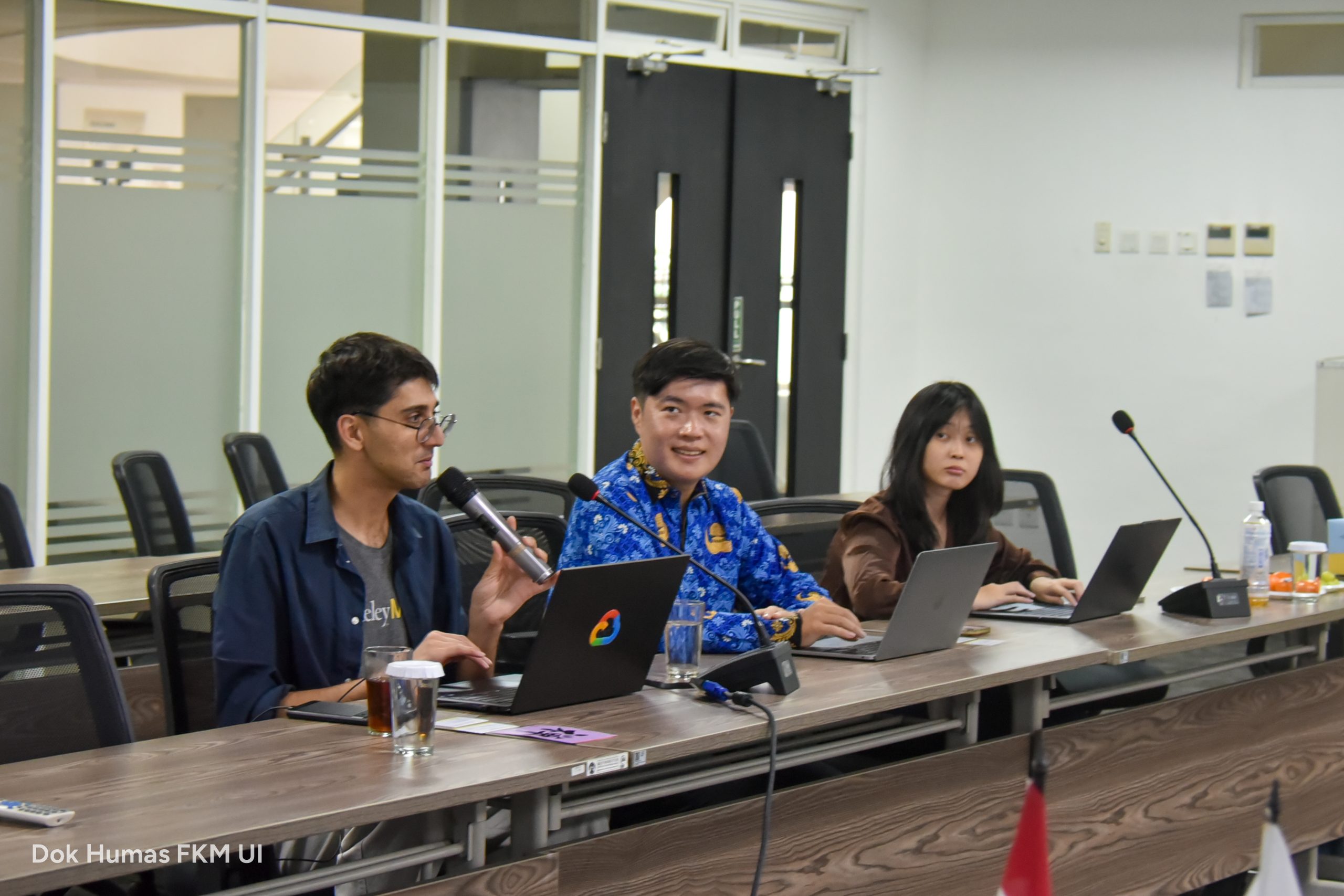
Depok, 5 December 2025 — In an effort to strengthen research innovation and academic contributions to the development of global health technology, the Faculty of Public Health (FPH) of Universitas Indonesia (UI) held an exploratory meeting with Virufy, a global nonprofit organization developing artificial intelligence (AI)–based respiratory disease screening technology. The meeting took place on Friday, 5 December 2025, at Meeting Room PA 212, RIK Building, UI, and marked an initial step for FPH UI in exploring strategic collaboration with the potential to expand academic and research impact at the international level.
The meeting was attended by representatives from Virufy: Mr. Amil Khanzada (Founder & CEO), Ms. Gabriella Gunarto (Business Development for the Asia Region), and Mr. Kenmaru Suedomi (One Young World Ambassador). Representing FPH UI were the Dean of FPH UI, Prof. Mondastri Korib Sudaryo; Manager for Partnerships, Alumni Relations, and Ventures, Prof. Dr. Indri Hapsari Susilowati, S.K.M., M.K.K.K.; and Secretary of the Department of Environmental Health, Fitri Kurniasari, S.K.M., M.K.K.K., Ph.D.
Dean of FPH UI, Prof. Mondastri, opened the meeting with enthusiasm and emphasized that such collaboration aligns with the faculty’s strategic direction. “This is a very good moment for both parties to discuss possible collaborations that can be pursued together,” he stated. Prof. Mondastri highlighted that international collaboration grounded in innovative research is an essential part of FPH UI’s commitment to becoming a center of excellence that is responsive to developments in global health technology.
The meeting continued with a presentation by Amil Khanzada, who introduced Virufy’s AI-based application capable of analyzing respiratory diseases—including COVID-19—through users’ cough sounds. In his presentation, Amil explained the significant potential of this technology to support population surveillance and diagnostic assistance, particularly in countries with a high burden of respiratory diseases such as Indonesia.
The discussion then focused on two main agendas as initial points for collaboration exploration. The first agenda concerned opportunities for clinical validation and data collection, including the possibility of conducting joint studies to collect local respiratory audio data, particularly in the context of tuberculosis (TB) as a primary focus. Virufy also outlined opportunities for pilot projects starting in mid-2026, targeting locations such as primary health care centers (puskesmas), traditional markets, public gathering places, student dormitories, and industries with high air-exposure risks.
Furthermore, the meeting explored opportunities for UI student involvement in Virufy’s global team through internships, research projects, and cross-disciplinary contributions such as programming, project management, marketing, and business development. These opportunities are expected to provide global learning experiences for students, in line with FPH UI’s vision to prepare graduates who are adaptive and internationally competitive.
During the Q&A session, the Secretary of the Department of Environmental Health, Fitri Kurniasari, inquired about the possibility of data collection without induced coughing. Virufy explained that AI model quality is highly dependent on the consistency of cough characteristics; therefore, uncontrolled coughing tends to reduce sensitivity and specificity. In response, Prof. Mondastri emphasized FPH UI’s position in the collaboration. “FPH UI intends to play an equal role as a research partner, not merely as data collectors,” he stated. Virufy subsequently affirmed its commitment to fully involve FPH UI in all stages of joint research, including research co-design and scientific publications, as well as sharing comparative research findings from other countries to ensure global integration of the studies.
Meanwhile, Kenmaru Suedomi added an international perspective, noting that investment in technologies such as Virufy is crucial, as demonstrated in Japan, and therefore this collaboration deserves serious consideration to strengthen Indonesia’s health system.
This exploratory meeting underscores FPH UI’s progressive steps in building innovative, cross-country, and technology-driven research collaborations. With potential cooperation in research, pilot projects, and student engagement, FPH UI hopes that collaboration with Virufy will become a significant breakthrough in strengthening national capacity for respiratory disease surveillance and early detection, while further reinforcing FPH UI’s position as a strategic partner in global health innovation. (wrk)